A report from Aircraft Interiors Expo 2026, the world’s leading exhibition dedicated to commercial aircraft cabin interiors. Held in Hamburg this year on the occasion of its jubilee 25th edition.From 14 to 16 April 2026. Hamburg Messe hosted the 25th edition of Aircraft Interiors Expo, the most significant trade event in the world focused exclusively on civil aircraft interiors. We attended as representatives of APRAM Aerospace in the role of observers and partners. The modernization of narrow-body fleets is one of the major drivers of demand for consumable and repair parts on the aftermarket. “The exhibition is an important barometer for us it shows. What manufacturers are preparing and where the industry is heading,” explains Alena Šimečková, CEO of APRAM Aerospace.
This year’s edition welcomed 479 exhibitors and approximately 12,000 trade visitors from around the world. Almost half of them came from Europe, just under a fifth from North and South America, the same share from. The Asia–Pacific region, and the remainder from the Middle East and Africa. The programme was structured around three main thematic lines that ran through all three days of the exhibition. Sustainability and the recyclable economy, digitalization of the passenger experience, and the rapidly growing importance of the business aviation segment.
- A New Zone For Business Aviation
- AI-enabled seats Narrow-body Modernization In Full Swing
- Airspace First Class Airbus Pushes The Luxury Frontier
- Cabin Digitalization And, Again, Artificial Intelligence
- Recyclable Materials In The Passenger Cabin
- Move Toward Measurable Sustainability
- Crystal Cabin Awards Recognition of Creative Ability And Modernization
- The supply chain in Europe is changing
- European Consolidation Supply Chain
- What this means for the spare-parts business
- The Third Conclusion Relates To Professionalism And Expertise
- Conclusion
A New Zone For Business Aviation
A novelty of this year’s edition was a dedicated BizJet Interiors Zone in Hall B1. It responds to an economic shift that has become impossible to overlook in recent years. The global business jet market is estimated to grow from 48 billion dollars in 2025 to nearly 68 billion by 2032. In the context of the entire fair, this segment is also relevant for those who do not work directly with private aviation. According to organizer Archana Dharni, business jets function as a testing ground for the industry. The materials, lighting solutions and digital interfaces that appear today in luxury cabins typically migrate into commercial fleets within five to ten years. Watching this segment therefore helps anticipate what an Airbus A320 or Boeing 737 cabin will look like a few years from now.
AI-enabled seats Narrow-body Modernization In Full Swing
If this year’s edition had one dominant theme, it was seating, and in particular. The modernization of seats in the A320 and B737 fleets, which are a key area for APRAM Aerospace. Collins Aerospace announced that it has secured three launch airline customers for its new economy seat Helix. With installations on approximately 200 aircraft. Every such transition generates long-term demand for follow-on parts, consumables and support during the retrofit campaign. Germany’s RECARO Aircraft Seating one of the most important manufacturers of economy-class seats announced annual revenues of 710 million euros and production of nearly 120,000 seats. At its booth it presented the technology prototype R7 Horizon for business class. Which according to the company is roughly a fifth lighter than comparable solutions. And includes voice control in more than ninety languages powered by AI. The integration of artificial intelligence directly at the seat level signals a clear direction.
The second major novelty was the concept seat R Sphere, which won a Crystal Cabin Award in the sustainability category. It saves approximately 1.5 kilograms per passenger, and its construction allows modular replacement of components during maintenance. Which has a non-negligible impact on the lifecycle of the aircraft interior. The French company Expliseat, a specialist in ultra-light titanium and carbon seats, used the Hamburg event to announce its entry into the U.S. Market and to launch for the first time a business-class product. TiSeat S, designed for regional aircraft Embraer E-Jet and Bombardier CRJ. Weight savings compared with traditional solutions reach up to forty percent. Thompson Aero Seating, Unum Aircraft Seating and Elevate Aircraft Seating (a new Boeing brand) presented premieres for the A350 and Boeing 787 a market where bids for orders from major airlines are increasingly competitive.
Airspace First Class Airbus Pushes The Luxury Frontier
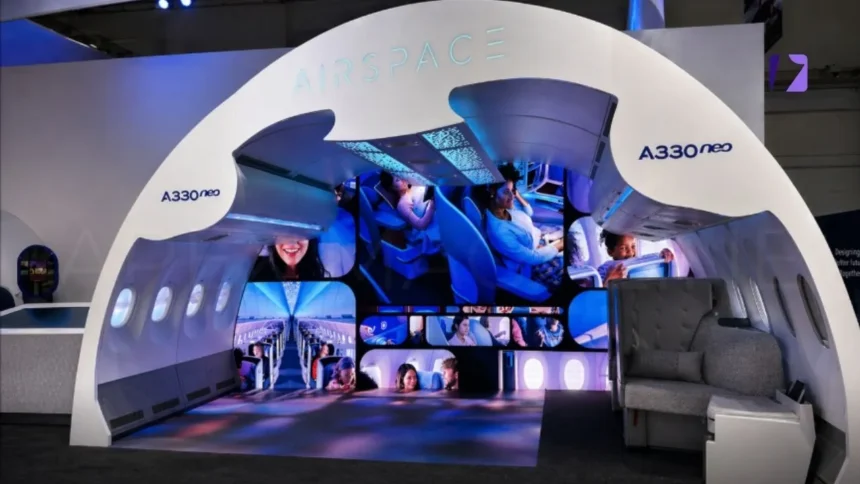
The most media-prominent moment of the exhibition belonged to Airbus and its Airspace “First Class Experience” concept for the A350-1000. A complete mock-up was presented in Hamburg, with a centrally located Master Suite for two passengers. Complemented by its own bathroom, dressing area, bar and double bed. The configuration of three suites in a row required a complete rebuild of the front section of the passenger cabin. At present, only two airlines operate a first class on this aircraft type, with about five more. he preparation phase, and entry into service is expected from 2030. The strategic dimension is clear: Airbus wants to anchor the A350-1000 as the top long-haul aircraft before the Boeing 777X enters service.
Cabin Digitalization And, Again, Artificial Intelligence
The IFEC zone for in-flight entertainment and connectivity hosted 77 exhibitors and made the direction of development obvious: a move away from closed proprietary systems toward scalable platforms that can be progressively expanded and updated. Thales presented the new generation FlytEDGE Aura with 4K HDR10+ Tandem OLED screens. Panasonic Avionics introduced the eXNeo system aimed at modernizing older aircraft without a complete hardware swap. Rosen Aviation showed Avia, an immersive 3D onboard assistant powered by artificial intelligence. Designed to go beyond plain voice control and make contextual decisions based on passenger behaviour. RAVE Aerospace went through a rebrand and presented an entire ecosystem of connected digital services. Including AI-driven search and a conversational interface. Looked at together, these announcements reveal a meaningful pattern.
AI is no longer a marketing layer added on top of existing IFE systems. It is becoming the primary interaction layer between the passenger and the aircraft. The implications for parts distribution are not immediate, but they are real. As software and AI-driven components become central to the cabin, the value chain shifts further toward digital updates. Sensors, and integrated assemblies, and the boundary between hardware part and software-defined function continues to blur. On the data connectivity side, several technically important novelties were presented. ThinKom revealed a compact-format antenna capable of simultaneous operation across GEO, MEO and LEO satellite constellations. Which is one of the consequences of consolidation in the satellite segment around operators such as Starlink and Viasat. SES announced a partnership with Google to standardize the connection of Android devices to onboard Wi-Fi – seemingly a detail. Yet one that will affect the daily experience of millions of passengers.
Recyclable Materials In The Passenger Cabin
One of the exhibits that drew our attention the most was a printer from the German company AIM3D. Combined with the ULTEM Recycle material from the SABIC group. The technology does not work with classical filament but directly with plastic granulate. Which according to the manufacturer makes the material costs up to seven times lower than with filament-based printers. In tests with ULTEM 9085 – a traditional aerospace plastic compliant with FAR 25.853 and UL94 V-0. Standards printed parts achieve tensile strength comparable to parts made on injection-molding lines.
More important than the economics of printing, however, is the sustainability dimension. SABIC presented a closed-loop principle: parts made from ULTEM materials. Whether end-of-life cabin components or production offcuts. Are ground into granulate and re-printed into functional components that retain the original regulatory certification. In practice this means that the material footprint of an aircraft interior can begin to close. Without forcing the manufacturer to abandon qualified materials. For aftermarket parts distribution this is a significant signal material origin documentation and traceability are likely to grow in importance. While the category of locally printed spare parts may obtain its own certification pathways in the coming years.
Move Toward Measurable Sustainability
The move toward measurable sustainability was visible across the entire show floor. SEKISUI KYDEX presented the thermoplastic KYDEX ECO 6565HI, designed with the help of life-cycle analysis. A consortium led by the Gen Phoenix brand together with Boeing. The Teague design studio, Elevate Aircraft Seating, Aerofoam and the Müller Textil group introduced the CirculAir Guide. A methodological document that anchors the principles of circularity in seat design from the very first conceptual phases. In parallel, Emirates announced the expansion of its own programme for traceable processing of decommissioned interiors. Including a certified volume of recycled material and the transformation of leather covers from retired A380s into fashion and specialty products.
For a parts distributor focused on long-term operating fleets, this trend has direct practical implications. Aircraft interiors that are designed for circularity from the outset with modular seats, recyclable thermoplastics. And traceable materials will require a different type of aftermarket support. Documentation, recyclate certificates and material lineage are becoming part of the parts package itself, not an optional add-on.
Crystal Cabin Awards Recognition of Creative Ability And Modernization
The 25th edition of the Crystal Cabin Awards was announced at the Hamburg Chamber of Commerce on 14 April. Diehl Aviation won the accessibility category for the AURS system, which enables visually and hearing-impaired passengers to navigate the onboard lavatory. Collins Aerospace took the comfort category for the SkyNook concept, a semi-private rest zone at the rear of the cabin. AviusULD won in cabin technologies for the Smart Fire Tag for cargo containers. Delta Air Lines took the IFEC category for the Connected Onboard Platform, which unifies in-flight entertainment, connectivity and operational data into a single data architecture. RECARO won the sustainability category for the R Sphere seat. The start-up Quvia took the newly introduced Breakthrough Start-ups category for an AI-driven tool for analyzing the digital onboard experience.
The supply chain in Europe is changing
The choice of Hamburg as host city for AIX is no accident. The city is the second-largest aviation hub in the world, home to Airbus production facilities, the European headquarters of Lufthansa Technik and hundreds of subcontractors. This was reflected in the composition of exhibitors this year: German manufacturers dominated, both long-established names and a number of newer brands using the fair as a gateway to the European market.
A striking feature of this year’s edition, compared to previous years, was the marked absence of Chinese companies. The only Chinese exhibitor was the seat manufacturer Jiatai, more specifically Hubei Hangyu Jiatai, which after the show announced contracts with the airlines VietJet, Air Arabia, Flyadeal and Ethiopian Airlines. Together, these contracts cover more than one hundred aircraft with deliveries through 2030, suggesting that Chinese seat manufacturers remain active above all toward airlines from Southeast Asia, the Middle East and Africa.
European Consolidation Supply Chain
The second commercially relevant line was the European consolidation of the supply chain. European interior component manufacturers are investing heavily in increasing stock capacity and shortening lead times. One route they are taking is to acquire licenses for the production of U.S.-manufacturer products directly in Europe. A concrete example is the Trelleborg group, which this year acquired a license for the manufacture of Magee Plastic window shades, cabin panels and other components. For airlines this means shorter lead times, the avoidance of customs barriers and certification directly under EASA. In the same spirit, the Danish company LEKI Aviation announced the expansion of its distribution portfolio.
This shift naturally changes some of the rules in the sale of spare parts. A growing number of new aircraft and retrofit programmes today emerge from direct contracts between OEM and airlines, which bypass the traditional supply chain. For a distributor it means a shift of emphasis from broad portfolio breadth toward specialization in segments where added value remains irreplaceable – AOG deliveries within hours, rotable components with complex history, consumables for specific aircraft types and operational support during cabin refresh projects. For APRAM Aerospace, which has long focused on the A320 and Boeing 737 fleets, this is an environment in which specialization, delivery speed and proven quality processes are gaining importance.
What this means for the spare-parts business
For a parts distributor such as APRAM Aerospace, three practical conclusions emerge from this year’s edition. First, the renewal of passenger seats is gaining real momentum – the Collins Aerospace agreement covering two hundred aircraft is just the tip of the iceberg, and a series of similar contracts can be expected in the coming years. Each such modernization will trigger long-term demand for related materials, repair components and consumable parts.
Second, the gradual adoption of additive manufacturing in the aircraft cabin interior segment is changing the rules of the game for some part categories. Certification pathways for printed components are still taking shape – whether through PMA, Designated Engineering Representative or EASA Form 1 processes – and their distribution will require a new level of documentation, origin tracking and quality management. Combined with the parallel push toward AI-assisted design, lifecycle analysis tools and digital material passports, this is shaping up to be one of the deeper structural shifts in the cabin parts business of the next decade.
The Third Conclusion Relates To Professionalism And Expertise
Pressure on material traceability will increase, and for a distributor with mature processes this represents an opportunity to strengthen the role of trusted partner rather than a threat to the existing position. “This is absolutely essential. At APRAM Aerospace we have used a professional system since the company was founded, tailored directly to the requirements of customers and partners. From the very beginning, all processes have been set up in great detail and we strictly track the lineage of every part. The customer can therefore receive documentation going back even fifteen years on request,” adds executive director Alena Šimečková.
The passenger cabin has, over the quarter-century mapped by Aircraft Interiors Expo, transformed more than most other parts of the aircraft. From the first reclining beds in first class to today’s combination of recyclable materials, 3D-printed components and onboard AI assistants, interior modernization is unfolding faster than was often expected. For those of us who deal with the logistics of spare parts for the A320 and B737, it is important to follow these trends not just as a technical curiosity but as a factor that within a few years will define what parts, in what volumes and with what documentation airlines will need.
Conclusion
The 25th edition of the Aircraft Interiors Expo made one thing unmistakably clear aircraft cabin innovation is no longer incremental it is structural. From AI-integrated seating and digital passenger interfaces to recyclable materials and additive manufacturing. The entire ecosystem of aircraft interiors is being redefined. These changes are not confined to OEM design studios. They are already reshaping aftermarket demand, supply chain models, and certification frameworks.
For companies like APRAM Aerospace, the implications are practical and immediate. The acceleration of narrow-body fleet modernization. Especially across the Airbus A320 and Boeing 737 platforms, will drive sustained demand for consumables, repair parts, and retrofit support. At the same time, the rise of digitally enabled cabins and circular material systems will require a higher standard of traceability, documentation, and technical expertise.
Ultimately, the future of the spare-parts business will be defined by adaptability. Distributors that can combine speed, specialization, and rigorous quality processes. An understanding of emerging technologies will not only keep pace with industry evolution they will help shape it.
VISIT MORE: APEX MAGAZINE