

The Baltimore Ravens vs Buffalo Bills match player stats in the 2025 NFL season delivered one of the most thrilling games of the year, featuring a historic comeback and unforgettable performances by star players on both sides. The game ended with a dramatic 41–40 victory for the Bills after overcoming a large deficit late in the fourth quarter. This contest showcased elite quarterback play, explosive offense, and key strategic moments that shaped the final result. Beyond the final score, the player stats reveal how both teams executed their offensive and defensive game plans in a high‑stakes battle that NFL fans will remember for years.
Quick Match Summary Table
| Attribute | Details |
|---|---|
| Date | September 7, 2025 |
| Venue | Highmark Stadium, Orchard Park, NY |
| Final Score | Bills 41 – Ravens 40 |
| Quarter Scores | Q1: 7–3 Bills/Ravens, Q2: 6–17, Q3: 6–14, Q4: 22–6 |
| Total Yards | Ravens: 432, Bills: 497 |
| Passing Leaders | Josh Allen (394 yds), Lamar Jackson (194 yds) |
| Rushing Leaders | Derrick Henry (169 yds), James Cook (44 yds) |
| Receiving Leaders | Zay Flowers 143 yds, Keon Coleman 112 yds |
| Time of Possession | Ravens: 25:11, Bills: 34:49 |
Quick Match Score Table
| Team | Q1 | Q2 | Q3 | Q4 | Final |
|---|---|---|---|---|---|
| Baltimore Ravens | 3 | 17 | 14 | 6 | 40 |
| Buffalo Bills | 7 | 6 | 6 | 22 | 41 |
Team Lineups and Starting Players
The Ravens and Bills each fielded strong starting lineups with a combination of veteran leaders and dynamic playmakers. For Baltimore, Lamar Jackson led the offense at quarterback, backed by running back Derrick Henry, who provided a powerful ground attack. Wide receiver Zay Flowers was a focal point in the passing game, creating separation and gaining yardage after the catch. Buffalo relied heavily on Josh Allen at quarterback, whose dual‑threat ability kept the Ravens’ defense under pressure throughout the match. James Cook and receiving threats like Keon Coleman and Dalton Kincaid contributed in key moments, while special teams and defensive starters played roles that impacted possession, field position, and momentum.
- Quick Match Summary Table
- Quick Match Score Table
- Team Lineups and Starting Players
- First Quarter Performance and Key Plays
- First Quarter Performance and Key Plays
- Third Quarter Analysis and Turning Points
- Third Quarter Analysis and Turning Points
- Top Performers for Baltimore Ravens
- Top Performers for Buffalo Bills
- Statistical Overview: Offense
- Statistical Overview: Defense
- Special Teams and Impact Plays
- Team Strategies and Game Plan Analysis
- Injuries and Their Impact on the Game
- Post‑Match Reactions and Player Interviews
- Post‑Match Reactions and Player Interviews
- Conclusion
- Frequently Asked Questions
First Quarter Performance and Key Plays
The opening quarter was tightly contested as both offenses aimed to establish rhythm early. Buffalo struck first with a touchdown pass from Josh Allen to Dalton Kincaid, giving them a lead before Baltimore responded with a 52‑yard field goal from Tyler Lupp, demonstrating the Ravens’ ability to move into scoring range. The first quarter set the tone for a back‑and‑forth affair, with both teams showcasing offensive balance. The Ravens mixing passes and runs effectively while the Bills kept the pressure on through quick strike opportunities. Strategic decisions on fourth‑down attempts and early defensive adjustments shaped the momentum, with each unit working to outmaneuver the opponent’s scheme.
First Quarter Performance and Key Plays
The opening quarter was tightly contested as both offenses aimed to establish rhythm early. Buffalo struck first with a touchdown pass from Josh Allen to Dalton Kincaid, giving them a lead before Baltimore responded with a 52‑yard field goal from Tyler Lupp, demonstrating the Ravens’ ability to move into scoring range. The first quarter set the tone for a back‑and‑forth affair, with both teams showcasing offensive balance. The Ravens mixing passes and runs effectively while the Bills kept the pressure on through quick strike opportunities. Strategic decisions on fourth‑down attempts and early defensive adjustments shaped the momentum, with each unit working to outmaneuver the opponent’s scheme
Third Quarter Analysis and Turning Points
The third quarter was marked by continued scoring from both teams as each sideline attempted to maintain momentum. Baltimore’s offense pushed the ball effectively on the ground, with Jackson and Henry combining to keep drives alive while testing the Bills’ front seven. Buffalo’s offense countered with timely passing and quick work on third downs to sustain possessions. The third quarter produced long sustained drives, forcing both defenses to adjust coverages and pressure packages, and though neither team seized complete control, the exchanges foreshadowed a tense final period filled with big plays and critical decision‑making.
Third Quarter Analysis and Turning Points
The third quarter was marked by continued scoring from both teams as each sideline attempted to maintain momentum. Baltimore’s offense pushed the ball effectively on the ground, with Jackson and Henry combining to keep drives alive while testing the Bills’ front seven. Buffalo’s offense countered with timely passing and quick work on third downs to sustain possessions. The third quarter produced long sustained drives, forcing both defenses to adjust coverages and pressure packages, and though neither team seized complete control, the exchanges foreshadowed a tense final period filled with big plays and critical decision‑making.
Top Performers for Baltimore Ravens
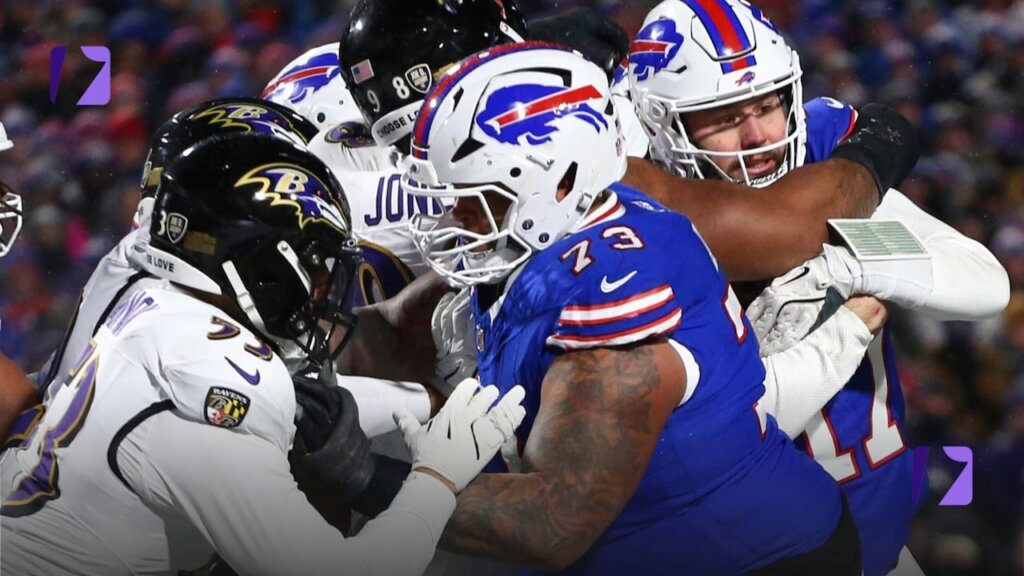
Baltimore’s offense was driven by Derrick Henry, who rushed for 169 yards and 2 touchdowns, using his size and strength to consistently gain yards after contact. Quarterback Lamar Jackson contributed both in the air and on the ground, completing numerous passes and adding a rushing touchdown. Zay Flowers emerged as a key receiving threat, finishing with 143 receiving yards, making crucial catches to sustain drives. Defensively, the Ravens made impactful tackles and generated pressure at critical moments, despite yielding late points. These contributions reflect a balanced performance, although the final result did not favor Baltimore
Top Performers for Buffalo Bills
Buffalo’s victory was largely propelled by the stellar play of Josh Allen, who threw for 394 yards with multiple total touchdowns, demonstrating his dual‑threat capability by extending plays with his legs and arm. Keon Coleman provided a significant receiving presence with 112 receiving yards, making key catches that helped sustain Buffalo’s final scoring drives. Dalton Kincaid also found success in the red zone early in the game. The Bills’ ability to maintain possession and make pivotal plays in the fourth quarter highlighted their depth and composure under pressure, with special teams ultimately securing the win.
Statistical Overview: Offense
Offensively, the Ravens finished with 432 total yards, including a potent 238 rushing yards and 194 passing yards, indicating a game plan that heavily utilized the run while still creating opportunities through the air. Buffalo, meanwhile, amassed 497 total yards — 389 passing yards and 108 rushing yards — showcasing a balanced attack with an emphasis on vertical passing and third‑down conversions. The statistical contrast highlights Baltimore’s success on the ground and Buffalo’s aerial dominance, reflecting distinct offensive identities that made this matchup compelling.
Statistical Overview: Defense
Defensively, both teams had moments of impact, with rush‑stop units battling through blocks and assigning coverage to high‑impact receivers. The Ravens showed strength in run defense at times but faltered in late‑game pass coverage. The Bills’ defense adjusted in the second half to generate pressure on key downs while limiting big plays. Defensive statistics such as sacks, tackles for loss, and turnovers illustrated each unit’s execution under pressure, even as the scoreboard evolved rapidly in the final minutes.
Special Teams and Impact Plays
Special teams played a crucial role, especially in the game’s closing moments. Matt Prater’s game‑winning field goal as time expired underscored the importance of kicker accuracy and poise under pressure. In addition, field position from punts and kickoff returns influenced starting points for drives throughout the contest. The effectiveness of special teams units often goes overlooked, but in this matchup, those plays directly contributed to the thrilling outcome and illustrated the fine margins that separate victory from defeat in the NFL.
Team Strategies and Game Plan Analysis
Baltimore’s strategy focused on establishing the run early, keeping defenses honest by mixing Jackson’s passing and scrambling ability. This approach resulted in sustained drives and early control of the scoreboard. Buffalo countered with vertical passing, targeting mismatches and exploiting coverage breakdowns, especially in the second half. The Bills’ strategic adjustments in the fourth quarter — including increased urgency on third downs and clock management — ultimately tipped the scales. Both teams demonstrated disciplined playcalling, yet the execution in critical moments defined the narrative.
Injuries and Their Impact on the Game
Both teams faced physical challenges, with a few key players experiencing injuries that impacted substitutions and snap counts. While specific player injury details were not widely reported for this game, any mid‑game physical changes forced coaching staffs to adjust personnel and playcalling. In the NFL, even modest injuries can alter game flow, affecting blocking assignments, pass protection, and defensive rotations. These factors contribute to in‑game strategy and can influence critical drives, especially late in tightly contested games like this one.
Post‑Match Reactions and Player Interviews
After the game, coaches and players from both sides reflected on the hard‑fought contest. Ravens personnel acknowledged missed opportunities in late‑game defense and vowed to sharpen execution moving forward. Bills players praised their resilience under pressure, especially quarterback Josh Allen, whose leadership in the comeback drew widespread acclaim. Coaches emphasized learning outcomes from this matchup, noting that high‑pressure, last‑minute situations test depth, discipline, and mental toughness. Reactions from the locker room highlighted respect between competitors and the NFL’s competitive balance.
Post‑Match Reactions and Player Interviews
After the game, coaches and players from both sides reflected on the hard‑fought contest. Ravens personnel acknowledged missed opportunities in late‑game defense and vowed to sharpen execution moving forward. Bills players praised their resilience under pressure, especially quarterback Josh Allen, whose leadership in the comeback drew widespread acclaim. Coaches emphasized learning outcomes from this matchup, noting that high‑pressure, last‑minute situations test depth, discipline, and mental toughness. Reactions from the locker room highlighted respect between competitors and the NFL’s competitive balance.
Conclusion
The Baltimore Ravens vs Buffalo Bills matchup produced an unforgettable NFL game with dramatic twists, elite performances, and significant statistical contributions from both teams. The Bills’ 41–40 win came through perseverance, strategic execution, and explosive offense led by Josh Allen, while the Ravens demonstrated a powerful running attack and resilient defense. Player stats from this game tell a story of intense competition, individual brilliance, and strategic depth. Fans and analysts alike will revisit this contest as one of the season’s most thrilling moments, with lessons for both teams as the NFL season progresses.
Frequently Asked Questions
Who won the Ravens vs Bills game?
The Buffalo Bills won the game 41–40 in a dramatic fourth‑quarter comeback.
Who was the top passer in the game?
Josh Allen led all passers with 394 passing yards.
Who led rushing for the Ravens?
Derrick Henry led Baltimore with 169 rushing yards and 2 touchdowns.
How many total yards did each team gain?
The Ravens gained 432 total yards, while the Bills gained 497 total yards.
What was the game‑winning play?
A 32‑yard field goal by Matt Prater as time expired secured the Bills’ victory.
VISIT MORE: APEX MAGAZINE