
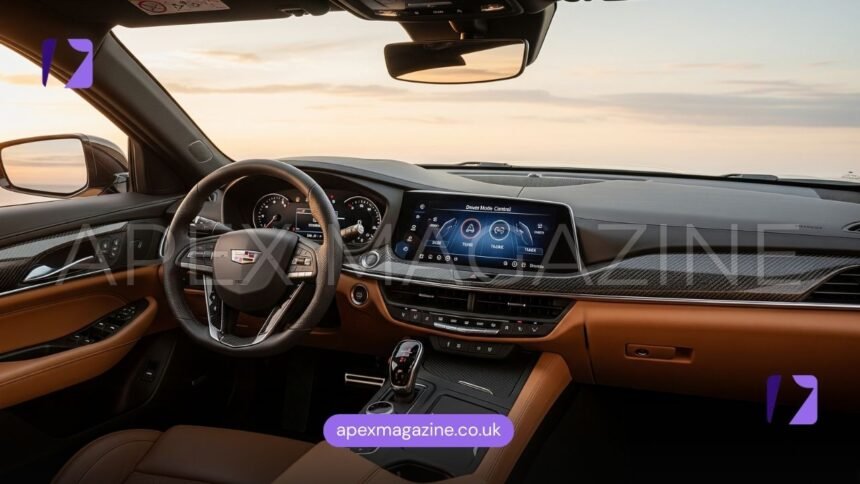
Cadillac vehicles are renowned for blending luxury with performance, and one feature that enhances this experience is driving modes. These modes allow drivers to adjust the vehicle’s handling, suspension, throttle response, and steering to match different driving conditions or preferences. Whether you’re cruising in the city, navigating highways, or tackling challenging weather, understanding these modes ensures a smoother, safer, and more enjoyable ride. Cadillac’s driving modes cater to both casual drivers seeking comfort and enthusiasts looking for performance, making each journey personalized.
In today’s automotive world, technology allows cars to adapt dynamically to the driver’s needs. Cadillac’s driving modes are part of this innovation, offering flexibility without compromising luxury. By switching between modes, you can transform your vehicle’s behavior, emphasizing either efficiency, sportiness, or stability depending on your priorities. For owners, mastering these modes is not just a convenience—it elevates the driving experience and allows them to extract the maximum potential from their Cadillac.
- Quick Facts About Cadillac Driving Systems
- What Are Driving Modes in Cadillac?
- How Driving Modes Affect Performance and Handling
- Comfort Mode: Smooth Driving for Everyday Journeys
- Sport Mode: Maximizing Power and Responsiveness
- Eco Mode: Efficiency and Fuel Savings
- Snow/Ice Mode: Safety in Challenging Conditions
- Individual or Personalized Mode: Tailoring Your Driving Experience
- Transmission and Suspension Adjustments in Different Modes
- Steering and Throttle Response Changes
- Impact of Driving Modes on Fuel Efficiency
- Choosing the Right Mode for Your Cadillac Model
- Common Myths About Cadillac Driving Modes
- Tips for Getting the Most Out of Your Driving Modes
- Conclusion
- Frequently Asked Questions
Quick Facts About Cadillac Driving Systems
| Feature | Details |
|---|---|
| Vehicle Brand | Cadillac |
| Driving Modes Available | Comfort, Sport, Eco, Snow/Ice, Personalized/Individual |
| Suspension | Adaptive Magnetic Ride Control (selected models) |
| Steering Response | Adjusts automatically with mode selection |
| Throttle Sensitivity | Varies per driving mode for acceleration control |
| Launch Year | First introduced in Cadillac CTS (2014) |
| Available Models | CT4, CT5, XT4, XT5, Escalade, and more |
| Mode Selection | Center console dial or touchscreen interface |
| Fuel Efficiency Impact | Eco mode enhances MPG, Sport may reduce efficiency |
| Safety Integration | Modes adjust traction control, stability, and braking |
What Are Driving Modes in Cadillac?
Driving modes in Cadillac allow the driver to customize vehicle performance based on environment, comfort, or sport preference. Each mode changes how the car behaves by adjusting engine output, transmission response, steering feel, and suspension stiffness. These modes are especially useful in luxury sedans and SUVs, where versatility enhances daily driving while ensuring the vehicle remains comfortable, safe, and responsive in different conditions.
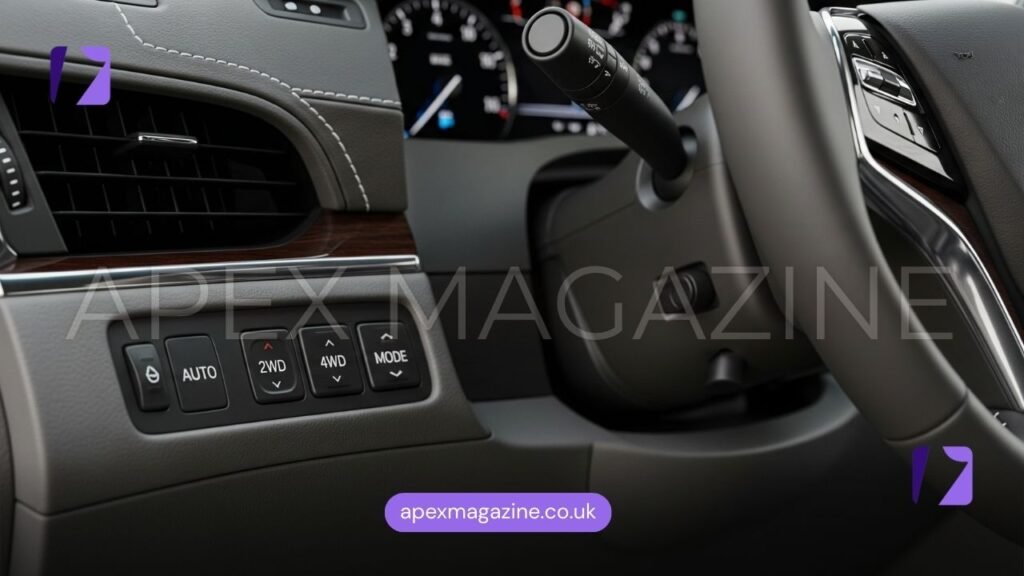
Cadillac uses a combination of electronic controls and mechanical adjustments to create distinct driving experiences. Modes can be selected via the center console dial, touchscreen interface, or even steering wheel buttons in certain models. Whether prioritizing efficiency for long trips or performance for spirited driving, these modes give drivers full control over how their Cadillac responds, making every journey enjoyable and tailored to their needs.
How Driving Modes Affect Performance and Handling
The selection of a driving mode directly affects the vehicle’s acceleration, braking, and cornering behavior. For example, Sport mode sharpens throttle response, stiffens suspension, and tightens steering for precise control at higher speeds. Conversely, Comfort mode softens these parameters, delivering a smooth ride with minimal body movement, ideal for city or highway driving.
Driving modes also interact with traction and stability systems, ensuring the Cadillac responds optimally to road conditions. In challenging scenarios such as wet surfaces or icy roads, Snow/Ice mode adjusts throttle, braking, and torque distribution to maintain traction. Understanding how each mode modifies performance allows drivers to select the most appropriate setting, maximizing both safety and enjoyment.
Comfort Mode: Smooth Driving for Everyday Journeys
Comfort mode prioritizes a smooth, relaxed driving experience. The suspension softens to absorb road imperfections, steering becomes lighter for effortless maneuvering, and throttle response is moderated to prevent abrupt acceleration. This mode is ideal for commuting, urban traffic, or long-distance highway travel, where minimizing driver fatigue is a priority.
Comfort mode also subtly enhances interior ambiance by maintaining quiet cabin levels and smooth gear shifts. Drivers can enjoy Cadillac’s luxury features without the distraction of overly stiff suspension or aggressive handling. By combining technology and refinement, Comfort mode ensures that daily journeys feel effortless, emphasizing relaxation and control.
Sport Mode: Maximizing Power and Responsiveness
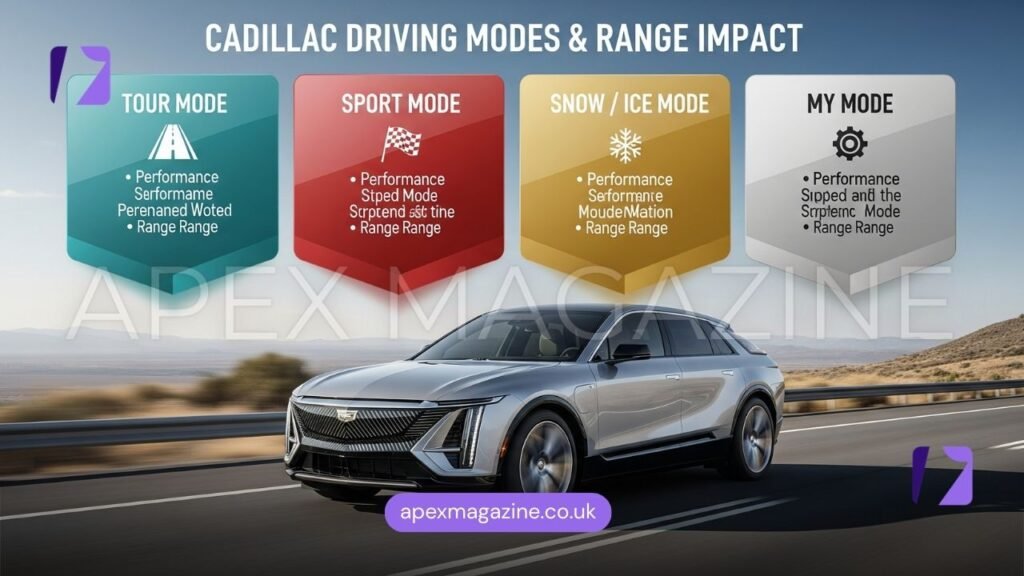
Sport mode transforms the Cadillac into a performance-oriented machine, ideal for drivers seeking dynamic handling and aggressive acceleration. Engine response becomes sharper, transmission shifts quicker, and steering feels tighter, allowing precise control in curves and high-speed conditions. Suspension stiffens to minimize body roll, enhancing confidence when pushing the car to its limits.
This mode is perfect for spirited drives on winding roads or highway overtakes, where precision and responsiveness matter. Sport mode also heightens auditory cues, allowing the engine’s performance to be felt and heard. By combining mechanical adjustments with electronic tuning, Cadillac delivers a thrilling yet controlled performance experience for those who prioritize driving excitement.
Eco Mode: Efficiency and Fuel Savings
Eco mode focuses on maximizing fuel efficiency without sacrificing overall performance. Throttle response is softened, gear shifts occur at lower RPMs, and systems like air conditioning may be optimized to reduce energy consumption. Drivers can extend fuel range during city commutes or long highway trips, making Eco mode practical for everyday use.
While Eco mode prioritizes efficiency, Cadillac ensures the car remains responsive enough for safe driving. Steering and braking remain balanced, allowing drivers to feel in control. By choosing Eco mode, owners can reduce environmental impact and fuel costs while enjoying Cadillac’s refined ride and handling characteristics.
Snow/Ice Mode: Safety in Challenging Conditions
Snow/Ice mode adjusts the Cadillac’s traction, throttle, and braking for maximum safety on slippery roads. Acceleration becomes gradual, steering response softens slightly, and stability control systems are more active. This ensures that even in adverse weather, drivers maintain control while minimizing the risk of wheel spin or skidding.
Additionally, Snow/Ice mode often interacts with AWD (all-wheel drive) systems, distributing torque optimally between wheels. This mode is essential for Cadillac owners living in colder climates or areas with unpredictable weather. By automatically fine-tuning vehicle systems, it provides confidence and stability without requiring constant driver intervention.
Individual or Personalized Mode: Tailoring Your Driving Experience
Cadillac’s Individual/Personalized mode lets drivers customize settings for steering, suspension, throttle, and transmission according to their preferences. Drivers can create a mode that balances comfort and sportiness exactly as desired, offering a fully tailored experience for each trip.
This mode is ideal for drivers who frequently switch between city driving and performance roads. By programming personalized settings, the Cadillac adapts instantly, ensuring the driving experience matches both mood and environment. It demonstrates Cadillac’s commitment to innovation, flexibility, and driver-centered luxury.
Transmission and Suspension Adjustments in Different Modes
Driving modes in Cadillac dramatically influence transmission behavior and suspension performance, tailoring the vehicle to the driver’s environment and preference. In Sport mode, the transmission holds gears longer and shifts at higher RPMs to maximize acceleration and deliver a responsive, engaging ride. The suspension stiffens via Cadillac’s Magnetic Ride Control, enhancing handling, reducing body roll, and providing precise control during aggressive maneuvers. Conversely, in Comfort mode, the transmission shifts earlier for smoother acceleration and the suspension softens to absorb road imperfections, prioritizing a cushioned, relaxed ride for everyday driving.
These adjustments not only improve performance but also contribute to overall safety and vehicle stability. Drivers can feel the tangible difference in responsiveness, whether navigating tight corners, highways, or city streets. By understanding how each mode alters the car’s dynamics, Cadillac owners can exploit the engineering to suit conditions, ensuring optimal ride quality without sacrificing comfort, control, or durability. It highlights the brand’s commitment to blending luxury with adaptive technology.
Steering and Throttle Response Changes
Cadillac’s driving modes also modify steering and throttle response to match the selected driving style. In Comfort and Eco modes, steering is lighter and acceleration more gradual, making city driving, commuting, or long highway trips effortless. Sport mode sharpens steering feedback and quickens throttle response, providing heightened control and precision during dynamic driving. In Snow/Ice mode, throttle sensitivity is reduced to prevent wheel slip and enhance traction, ensuring the vehicle remains predictable on slippery surfaces.
These changes occur seamlessly, requiring no manual intervention from the driver. Cadillac’s systems automatically adapt, creating a dynamic yet intuitive experience that makes the car feel responsive without overwhelming the driver. By adjusting steering weight and engine responsiveness, Cadillac ensures that each driving mode delivers an appropriate balance of control, safety, and excitement, emphasizing the brand’s expertise in performance engineering.
Impact of Driving Modes on Fuel Efficiency
Driving modes affect fuel consumption by altering engine behavior, throttle mapping, and transmission logic. Eco mode prioritizes efficiency by softening acceleration, optimizing gear shifts, and managing auxiliary systems to reduce fuel usage. Sport mode, in contrast, increases performance at the expense of fuel economy, as the engine operates at higher RPMs and throttle input is more aggressive. Comfort mode provides a balanced approach, delivering moderate efficiency while maintaining smooth acceleration and a relaxed driving feel.
Selecting the appropriate mode allows drivers to balance fuel savings, comfort, and performance based on their priorities. Cadillac also offers visual and auditory feedback, so owners can track efficiency and adjust their driving style accordingly. This intelligent system helps maximize fuel economy without sacrificing responsiveness, proving that luxury and sustainability can coexist seamlessly in modern vehicles.
Choosing the Right Mode for Your Cadillac Model
Selecting the correct driving mode depends on vehicle type, driving conditions, and personal preference. Sedans such as the CT4 or CT5 benefit from Sport mode on highways for quick acceleration, while Comfort mode is ideal for city traffic. SUVs like the Escalade or XT5 often rely on Snow/Ice mode during winter and Comfort mode for long family trips, balancing stability, handling, and passenger comfort. Understanding the strengths of each mode ensures the Cadillac performs optimally in every scenario.
Experimenting with modes allows drivers to fully experience the vehicle’s capabilities. Switching between Comfort, Sport, Eco, Snow/Ice, or Personalized mode demonstrates how Cadillac adapts dynamically, improving control, efficiency, and ride quality. By aligning mode selection with environment and driver intention, owners unlock the full potential of performance, safety, and comfort, enhancing every journey behind the wheel.
Common Myths About Cadillac Driving Modes
One common misconception is that Cadillac driving modes are purely cosmetic or marketing gimmicks. Some drivers assume switching modes only changes dashboard lights or displays without affecting actual vehicle performance. In reality, each mode adjusts critical systems including throttle sensitivity, transmission logic, steering weight, and suspension stiffness. These changes are tangible, altering the car’s responsiveness and overall driving experience in meaningful ways. Ignoring these effects means missing out on the full potential of Cadillac’s engineering.
Another myth is that switching between modes frequently can damage the vehicle. Cadillac designs these systems for seamless operation, allowing drivers to transition modes at any time without risk. Understanding and debunking these myths encourages drivers to experiment with modes responsibly, enhancing safety, comfort, and performance. By embracing the technology, owners can fully appreciate Cadillac’s thoughtful integration of adaptive driving systems, making each journey more enjoyable and efficient.
Tips for Getting the Most Out of Your Driving Modes
To maximize the benefits of Cadillac’s driving modes, it is essential to experiment safely in different environments. For example, Sport mode can be tested on open roads or highways where quick acceleration and sharp handling are advantageous, while Comfort or Eco modes are ideal for city streets or long commutes. Observing how each mode affects throttle response, steering effort, and suspension feedback allows drivers to select the optimal setting for any situation.
Maintaining vehicle software updates is equally important for ensuring peak performance and reliability. Cadillac frequently refines mode behaviors through updates, improving responsiveness, efficiency, and safety features. By understanding the interaction between driving modes, road conditions, and personal driving style, owners can fully harness the capabilities of their Cadillac. This approach ensures a dynamic, safe, and tailored driving experience while maximizing both comfort and enjoyment.
Conclusion
Cadillac’s driving modes showcase the brand’s commitment to versatility, innovation, and driver-centered engineering. From Comfort and Eco modes that prioritize smooth rides and efficiency, to Sport and Snow/Ice modes that enhance performance and safety, each setting transforms the driving experience. Personalized modes further allow drivers to tailor steering, throttle, and suspension to their exact preferences, creating a truly bespoke ride. By understanding how these modes influence the vehicle, owners can unlock Cadillac’s full potential and enjoy a combination of luxury, control, and adaptability.
Mastering driving modes not only improves performance and fuel efficiency, but also enhances safety and overall enjoyment. Whether navigating city streets, highways, or adverse weather, selecting the appropriate mode ensures optimal handling, ride quality, and responsiveness. Cadillac’s seamless integration of technology and engineering empowers drivers to confidently adapt to every situation. Ultimately, driving modes elevate the Cadillac experience, blending sophistication, innovation, and control into every journey.
Frequently Asked Questions
What are the main driving modes in Cadillac?
Cadillac typically offers Comfort, Sport, Eco, Snow/Ice, and Personalized/Individual modes, with availability depending on the model.
How do driving modes affect fuel efficiency?
Eco mode improves fuel economy by softening throttle and optimizing gear shifts, while Sport mode prioritizes performance, which may reduce MPG.
Can I switch driving modes while driving?
Yes, Cadillac allows seamless mode changes while driving, and the car adjusts engine, transmission, and suspension instantly.
Does Snow/Ice mode work with all Cadillac models?
Snow/Ice mode is available on most AWD and select FWD Cadillac models for enhanced safety in slippery conditions.
What is Personalized/Individual mode?
Personalized mode lets drivers customize steering, suspension, throttle, and transmission settings for a tailored driving experience.
VISIT MORE: APEX MAGAZINE