
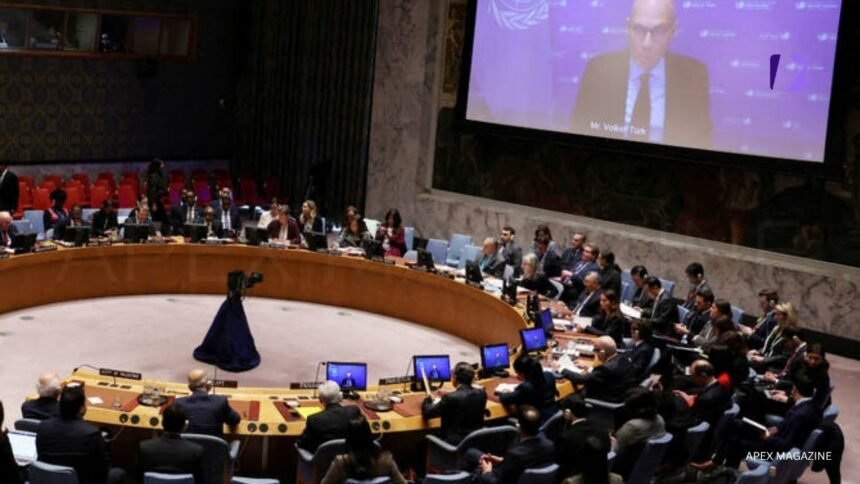
The United States staged a rare walkout during a United Nations Security Council meeting after France sharply criticised Washington’s human rights record, marking a new low in diplomatic relations between two of the body’s permanent members. The incident unfolded during a meeting focused on the war in Ukraine, where the U.S. delegation left the chamber as France’s ambassador began speaking.
The walkout followed days of escalating disagreements over the renewal of U.N. High Commissioner for Human Rights Volker Türk’s mandate. While France strongly supported the extension, the United States opposed it, setting the stage for a public diplomatic dispute.
Why the U.S. Walked Out
The U.S. delegation said it left the meeting in protest against what it described as France’s “disingenuous grandstanding” on human rights.
French officials had criticised the United States after it voted against extending Volker Türk’s four-year term as the U.N. human rights chief. France’s U.N. mission argued that Washington had isolated itself by joining a small group of countries opposing the renewal, a comparison that U.S. officials strongly rejected.
The Dispute Over Volker Türk
At the centre of the disagreement is the reappointment of Volker Türk, who has served as the United Nations High Commissioner for Human Rights since 2022.
The U.N. General Assembly voted overwhelmingly to extend his mandate for another four years, with 144 countries supporting the move. The United States was among only 10 countries that voted against the extension, arguing that the office has increasingly targeted democratic nations while failing to hold authoritarian governments sufficiently accountable.
France’s Criticism Sparks Diplomatic Tension
Following the General Assembly vote, France publicly criticised Washington’s position on social media and in diplomatic statements.
French officials suggested that the United States had aligned itself with countries frequently criticised for their own human rights records. Those remarks prompted a sharp response from senior U.S. diplomats, who accused France of using human rights for political point-scoring rather than constructive diplomacy.
What Happened During the Security Council Meeting
The Security Council meeting itself was primarily focused on Russia’s war in Ukraine.
However, tensions shifted away from Ukraine when France’s representative began addressing the Council. At that point, members of the U.S. delegation walked out of the chamber. Before leaving, U.S. officials criticised France’s recent comments and later confirmed that the protest was directed specifically at Paris’ rhetoric rather than the Security Council session itself.
U.S. Officials Defend Their Decision
American representatives said the walkout was intended to send a clear diplomatic message.
They argued that France had unfairly questioned America’s commitment to human rights and accused Paris of ignoring what Washington views as imbalances in the U.N. human rights system. U.S. officials also indicated they could repeat similar protests if France continues making comparable statements in future meetings.
France Reaffirms Its Position
France did not respond directly to the walkout during the Security Council meeting.
Instead, French representatives reiterated their support for the United Nations’ role in promoting peace, international cooperation, and the protection of human rights. Paris has maintained that its criticism reflects concern over recent U.S. positions rather than opposition to the broader U.S.-France alliance.
Growing Strains Between Longtime Allies
The latest incident reflects broader tensions that have emerged between the United States and several European allies.
Recent disagreements have included debates over NATO, international institutions, defence cooperation, and differing approaches to global diplomacy. Although Washington and Paris continue to work together on many international issues, public disagreements have become more frequent in recent months.
Why the Incident Matters
Walkouts during meetings of the U.N. Security Council are uncommon, particularly between two permanent members that traditionally cooperate on many international security issues.
Diplomatic observers say the protest highlights how disagreements over human rights and multilateral institutions are increasingly influencing broader foreign policy relationships. The incident also underscores the challenges facing the United Nations as member states remain divided on key governance and human rights questions.
What Happens Next?
Despite the diplomatic clash, Volker Türk’s second term has already been approved by the U.N. General Assembly, meaning the dispute is unlikely to change the outcome of the vote.
Attention will now turn to whether Washington and Paris can ease tensions or whether the disagreement will spill over into future Security Council discussions and broader international cooperation. Officials from both countries have not announced any formal diplomatic meetings aimed at resolving the dispute.
Stay More Update APEX MAGAZINE