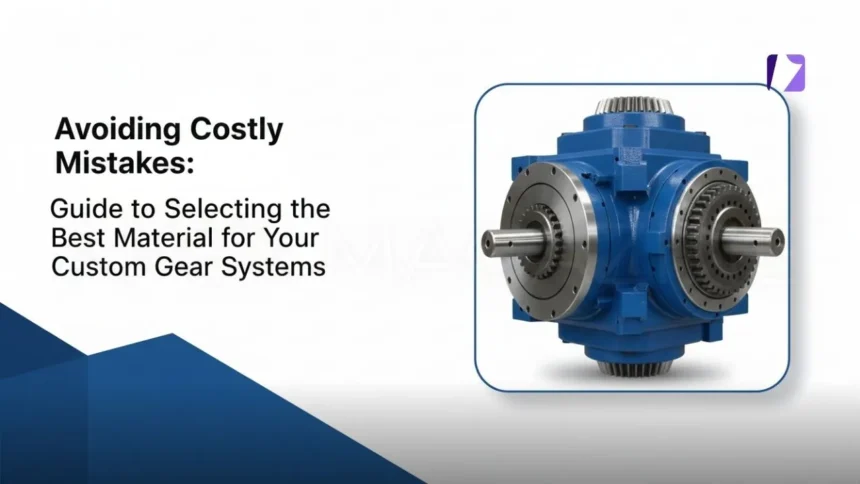
In the area of mechanical engineering, experts are generally confronted with the classic trade-off problemwhen designing custom gear systems: either selecting high-strength wear-resistant materials will result in extremely high costs and complicated machining processes, or selecting cost-effective materials may cause early failure under severe operating conditions, leading to substantial downtime and lost production. The problem essentially arises from conventional material selection procedures, which excessively rely on empirical equations and reference books, without conducting a comprehensive analysis of the actual operating conditions, such as impact loading, temperature, and lubrication conditions.
This commonly causes either over-engineering or under-designing. Based on two decades of precision manufacturing expertise, this article introduces a scientific material selection procedurethat systematically considers the interplay of operating conditions, material properties (such as fatigue strength and hardness), and cost-effectiveness. With this guide, experts can make optimal decisions that simultaneously consider performance, lifetime, and costs. The subsequent sections will break down the entire procedure for scientific material selection.
- How to Systematically Evaluate Operating Conditions to Determine Core Material Needs for Gears?
- Analyzing Key Operational Parameters
- Linking Parameters to Material Property Requirements
- Leveraging Authoritative Standards and References
- What Are the Common Gear Materials and Their Performance in Typical Applications?
- Metallic Alloys: Strength and Durability
- Non-Metallic Options: Lightweight and Corrosion Resistance
- Making the Right Choice for Your Scenario
- How Do Heat Treatment and Surface Treatments Significantly Enhance Gear Performance and Lifespan?
- How to Conduct a Cost-Benefit Analysis Without Compromising Gear Quality?
- Calculating Total Cost of Ownership
- Value Engineering for Optimum Design
- Case Example: Long-Term Savings Analysis
- Can Real-World Case Studies Demonstrate the Value of Scientific Material Selection?
- Case Background: Addressing Premature Failure
- Scientific Solution Implementation
- Measurable Outcomes and Benefits
- What Are the Step-by-Step Actions to Implement the Scientific Material Selection Framework?
- Conclusion
- Frequently Asked Questions
- Is there professional advice on choosing materials for low, volume production runs?
- How do we evaluate the feasibility of changing the material if not satisfied with the performance of our current gear material?
- What is the future outlook for new materials (such as composites) in gear applications, and how do they compare to traditional metals?
- Apart from the basic material, what else is essential for the final life of a gear in service?
- How reliable are predictions of gear life using material information and simulation models?
How to Systematically Evaluate Operating Conditions to Determine Core Material Needs for Gears?
Accurate diagnosis of operating conditions is the first step towards scientific material selection. This ensures that the material is perfectly suited to the operating conditions of the gear, avoiding over-specification and under-specification.
Analyzing Key Operational Parameters
The first step in material selection is to identify and quantify various parameters, which include torque, speed, type of load(constant or impact), temperature, lubricating conditions, and corrosive conditions. For example, high-torque conditions require materials with high yield strength, whereas variable conditions require materials with high fatigue strength. The list of parameters is exhaustive and serves as the basis for all other decisions.
Linking Parameters to Material Property Requirements
As discussed, each of these parameters plays a vital role in the determination of the properties that the materials should exhibit. For example, high temperatures require materials with high thermal stability so that the materials do not soften. Additionally, low lubrication environments require materials with inherent lubricity or the ability to be made lubricant compatible. In other instances, exposure to corrosive substances requires materials with improved corrosion resistance.
Leveraging Authoritative Standards and References
One of the ways to make your content more credible is to provide citations from publications that are considered highly reliable sources. For example, the ASM Handbook is a great reference that provides detailed criteria of how different materials behave in various service environments. In the surface gear machining services material selection guide, the authors thoroughly examine the interplay of fatigue life, hardness, and microstructure. The readers can treat this piece of information as a clue for further investigation. Also, the engineer could consult other resources if he wants to delve into the study of extreme condition analysis.
What Are the Common Gear Materials and Their Performance in Typical Applications?
Simply put, there are no best materials in gear manufacture. In fact, the best material is the one whose properties are best suited for the particular application. This chapter will review the most popular materials for gears and compare their performance and most suitable applications.
Metallic Alloys: Strength and Durability
Alloy steels, for example, 4140 and 4340, are well-known for their high strength-to-weight ratios and good hardenability. These materials have been used for automotive transmission and machine component gears. Another example is case-hardening steels, like 20CrMnTi, which have a hard surface for wear resistance and a tough core for impact resistance.
Non-Metallic Options: Lightweight and Corrosion Resistance
Nylon and POM are engineering plastics that have various benefits, such as lightweight operation, noise reduction, and natural corrosion resistance. These materials are best suited for food processing equipment, domestic appliances, and applications where weight reduction is of utmost importance. On the other hand, bronze alloys are selected based on their wear resistance and compatibility with steel parts, commonly used in worm gears and bushes.
Making the Right Choice for Your Scenario
The choice of materials should be guided by the requirements of the application rather than by the relative ranking of materials only. In aerospace applications, where it is very important to save weight and to ensure. Reliability, high, strength steels or titanium alloys are used even though their price is higher. Whereas, for low, speed, non, critical applications, cast iron or plastics make good substitutes. By comparing the strength, hardness, cost, and machinability, one can limit the options.
How Do Heat Treatment and Surface Treatments Significantly Enhance Gear Performance and Lifespan?
Although the choice of the base material is a factor, one should also pay equal attention to the post. Processing methods that significantly improve the performance and the durability of the gear parts. Core Enhancement Through Heat Treatment: Heat treatments such as carburizing, quenching and tempering. And induction hardening are the main methods that can be used to improve the properties of gear components. Carburizing, for instance, involves adding carbon to the surface of the gear component thereby greatly increasing its hardness and wear resistance. While the core still remains soft enough to absorb shocks and impacts. It is especially important that gear parts have both a hardened surface and a ductile core when they are subjected to repeated contact stress.
Surface Engineering for Superior Performance
Surface engineering comprises nitriding and Diamond. Like Carbon (DLC) coating which impart an extra layer of defense. Nitriding produces a hard and corrosion, resistant surface layer with minimum distortion which is ideal for making gears with very precise dimensions that require tight tolerances.
A DLC layer is also a very good option for reducing friction and wear, especially under conditions of poor lubrication. Both of these processes are widely utilized in the automotive and aerospace sectors in order to achieve performance standardsthat are better than ever. Ensuring Consistency Through Quality Controls: In demanding industries, following quality management systems. Such as ISO 9001 and IATF 16949very closely can allow heat treatment processes to become not only precisely controlled but also consistent. This is very important both for attaining the global standards and for delivering the performance that is replicable. Enterprises conforming to these standards have developed strong mechanisms that eliminate the risk of inconsistencies. Which might lead to premature breakdowns.
How to Conduct a Cost-Benefit Analysis Without Compromising Gear Quality?
A wise material selection approach is to look beyond the initial cost of the material to the overall cost of ownership, which includes the complexity of machining, cost of heat treatment, expected life, and any possible maintenance costs.
Calculating Total Cost of Ownership
TCO (Total Cost of Ownership) analysis considers various costs associated with the material over and above the material price. For instance, while steel is cheaper than other alloys, frequently replacing steel gears will cost more in the long run compared to using a costly higher, grade alloy that will last longer.
Value Engineering for Optimum Design
Value engineering is an approach that seeks to eliminate performance waste that is unnecessary. It is an approach that seeks to match the material perfectly with the application. For example, in the case of gears that are subjected to moderate loads, an ultra-high-strength alloy is overkill. It is better to use an alloy that is mid-grade and apply value engineering to the design to make sure that it is reliable.
Case Example: Long-Term Savings Analysis
Just consider a scenario where the carbon steel gear is initially more cost, effective but it only lasts 5, 000 hours thus necessitating replacements quite frequently. Whereas, an alloy steel gear, if subjected to the right heat, treatment. Can easily give you a service of 15, 000 hours with hardly any maintenance required. Even if the alloy steel gear is pricier, it still ends up having a lower TCO due to the fact. That the savings from fewer replacements and downtime more than make up for the higher initial cost.
Can Real-World Case Studies Demonstrate the Value of Scientific Material Selection?
Real-world case studies demonstrate the effectiveness of a scientific material selection approach in achieving success in the real world by applying theoretical concepts in a practical manner.
Case Background: Addressing Premature Failure
One of the leading manufacturers of construction equipment faced a continuous pitting problem on the gears made from 20CrMnTi material, with the gears lasting no more than 3000 hours.
Scientific Solution Implementation
The fail analysis and condition mapping indicated that the remedy was changing the material to 18CrNiMo7, 6 carburizing steel and modifying the heat treatment processes. The newly chosen material possesses both good core toughness and surface hardness, which enables it to withstand the most severe impacts. Along with the optimized process, implementation of tighter in, process controls to guarantee the product consistency was done.
Measurable Outcomes and Benefits
The results showed that the gear life was increased to above 8,000 hours, with a 70% decrease in failure rates. This change not only reduced maintenance costs but also improved machine reliability, proving the value of data-driven decisions.
What Are the Step-by-Step Actions to Implement the Scientific Material Selection Framework?
Applying the approach requires the execution of a systematic, five, step action plan that essentially transforms analysis into action thus, the project risks are lowered to a minimum.
Define Requirement Specifications: Start by making a detailed list of requirements that covers all load, environmental, and life parameters. This requirements list is basically a checklist that guarantees no requirements are overlooked.
Shortlist Candidate Materials: From the requirements, select 2-3 candidate materials that satisfy the key requirements. Data sheets and comparative charts are available that compare the performance of different materials with respect to one another. Especially with regards to strength, hardness, and cost.
Evaluate Manufacturing Feasibility: Then, the machinability and heat treatment necessities of the materials are checked. Manufacturing process evaluation is very important and includes the assessment of time. Tool wear, and availability of equipment that can perform the process. One great thing is to get in touch with manufacturing specialists that can give an enlightening opinion. About the possible problems that may be encountered during the process.
Simulate Cost-Benefit Scenarios: Here, the TCO of all the materials will be simulated. Considering their initial costs, processing costs, and lifespan. This will also enable the use of simulation techniques, which will aid. The visualization of the final outcome, thus creating a balanced approach for decision-making.
Prototype and Validate: Finally, prototypes will be created for validation testing under accelerated conditions. Validation testing will verify the predictions made, and the process will be fine-tuned before proceeding into full-scale production. This process is of utmost importance for applications of high consequence.
Conclusion
Thus, the selection of the best possible material for use in custom gear machining services is a complex process. However, if the working conditions are assessed and the interaction of materials with the process is well understood. Along with a detailed cost-benefit analysis, the performance-cost dilemma of materials can be overcome. This scientific approach will enable the creation of an optimized design. Which will result in a product with performance, longevity, and cost-effectiveness.
Frequently Asked Questions
Is there professional advice on choosing materials for low, volume production runs?
Definitely, various well, known manufacturers provide engineering support for material selection, and a low. Volume production run strategy will be considered in the choice of standard materials that are easily available to reduce cost and lead time. And through the supplier collaboration, the use of special heat treatments to attain the desired properties can also be considered.
How do we evaluate the feasibility of changing the material if not satisfied with the performance of our current gear material?
Initially, a failure analysis of the existing gears must be conducted, followed by defining new performance criteria. Afterward, the materials should be tested against the new criteria. And the assistance of the manufacturer can be sought fo rfailure analysis and modeling.
What is the future outlook for new materials (such as composites) in gear applications, and how do they compare to traditional metals?
There are a couple of benefits from new materials such as composites, for example, they are lightweight and corrosion resistant in certain applications, but theirload carrying capability and cost effectiveness are still significantly lower when compared with traditional metals. Generally, metallic alloys continue to be the predominant materials for heavy industrial applications, while new materials are utilized for niche markets only.
Apart from the basic material, what else is essential for the final life of a gear in service?
Besides the main material, there are a number of factors which are essential such as the absolute accuracy of the gear tooth profile, the exquisite manufacturing process, the uniformity of the heat treatment, the effectiveness of the lubrication system, and the correctness of installation alignment. Even the best material is powerless against design defects, inferior manufacturing, or unsuitable operating conditions.
How reliable are predictions of gear life using material information and simulation models?
Using current simulation models with precise load information and accurate material properties, predictions of gear life are quite reliable for compari son purposes and for detecting early signs of weakness. Nevertheless, prototype testing in real-life conditions is still the best method for final validation in high-stakes applications.
VISIT MORE: APEX MAGAZINE