

The March 10, 2026 matchup between the Detroit Pistons and the Brooklyn Nets turned into one of the most dominant performances of the season. Detroit controlled the game from the opening minutes and maintained momentum throughout all four quarters. The Pistons’ balanced offense, aggressive defense, and excellent ball movement overwhelmed Brooklyn early, leading to a commanding 138-100 victory. Fans witnessed one of the most efficient offensive nights for Detroit this season, with the team shooting over 56 percent from the field.
Beyond the final score, the game revealed important insights about both teams. Detroit demonstrated elite teamwork, recording 36 assists and maintaining strong defensive pressure that forced 19 turnovers from Brooklyn. Meanwhile, the Nets struggled to keep pace with Detroit’s fast tempo and physical interior play. The Pistons dominated the paint, scoring 64 points inside, while Brooklyn managed only 24. This difference in interior efficiency played a major role in determining the outcome of the match.
- Quick Score Table
- Match Overview and Final Score Summary
- Match Stats Table Stats
- First Quarter Performance Analysis
- Second Quarter Momentum and Key Plays
- Third Quarter Turning Points
- Fourth Quarter Closing Performance
- Top Performers from the Detroit Pistons
- Top Performers from the Brooklyn Nets
- Cade Cunningham’s Outstanding Playmaking Performance
- Jalen Duren’s Dominant Scoring and Efficiency
- Detroit Pistons Bench Contribution Breakdown
- Brooklyn Nets Offensive Struggles and Missed Opportunities
- Key Shooting Statistics and Field Goal Efficiency
- Defensive Impact and Turnover Analysis
- Rebounding Battle Between Pistons and Nets
- Assist Leaders and Playmaking Comparison
- Three-Point Shooting Performance
- Coaching Strategy and Game Management
- What This Win Means for the Detroit Pistons Season
- What the Loss Means for the Brooklyn Nets Moving Forward
- Conclusion
- Frequently Asked Questions
Quick Score Table
| Team | 1 | 2 | 3 | 4 | Final |
|---|---|---|---|---|---|
| Detroit Pistons | 38 | 35 | 32 | 33 | 138 |
| Brooklyn Nets | 27 | 13 | 33 | 27 | 100 |
Match Overview and Final Score Summary
From the opening tip, the Detroit Pistons showed their intent to dominate the game. Their offensive execution was nearly flawless in the first quarter, where they scored 38 points and quickly established control. Brooklyn attempted to respond with perimeter shooting, but inconsistent defense and turnovers made it difficult for them to maintain rhythm. Detroit’s offensive balance, including strong contributions from starters and bench players, allowed them to expand their lead steadily throughout the night.

Match Stats Table Stats
| Category | Detroit Pistons | Brooklyn Nets |
|---|---|---|
| FG | 48-85 | 29-69 |
| Field Goal % | 56 | 42 |
| 3PT | 16-31 | 13-38 |
| Three Point % | 52 | 34 |
| FT | 26-34 | 29-34 |
| Free Throw % | 76 | 85 |
| Rebounds | 40 | 31 |
| Offensive Rebounds | 10 | 7 |
| Defensive Rebounds | 30 | 24 |
| Assists | 36 | 23 |
| Steals | 12 | 3 |
| Blocks | 3 | 3 |
| Total Turnovers | 9 | 19 |
| Points Conceded Off Turnovers | 7 | 29 |
| Fast Break Points | 26 | 5 |
| Points in Paint | 64 | 24 |
| Fouls | 24 | 29 |
| Technical Fouls | 1 | 2 |
| Flagrant Fouls | 0 | 1 |
| Largest Lead | 43 | 0 |
| Percent Led | 99 | 0 |
First Quarter Performance Analysis
The first quarter established the tone for the entire matchup. Detroit’s offensive system operated smoothly as players moved the ball quickly and found open scoring opportunities. Their ability to attack both the perimeter and the paint created significant defensive pressure for Brooklyn. With efficient shooting and strong ball movement, the Pistons scored 38 points in the opening quarter, immediately placing the Nets in a difficult position.
Brooklyn struggled to keep up with Detroit’s tempo during this period. Defensive rotations were often late, allowing Detroit shooters to find open looks from three-point range. Additionally, the Pistons controlled rebounds and limited second-chance opportunities for Brooklyn. While the Nets managed 27 points in the quarter, their defensive inconsistencies allowed Detroit to build a comfortable early lead that would only expand as the game progressed.
Second Quarter Momentum and Key Plays
The second quarter proved to be the turning point where the Pistons completely seized control of the game. Detroit’s defense intensified, forcing multiple turnovers that quickly turned into fast-break points. Their ability to convert defense into offense created a rapid scoring run that Brooklyn struggled to stop. Detroit outscored the Nets 35-13 during this quarter, effectively deciding the outcome before halftime.
Brooklyn’s offense collapsed during this stretch due to poor shot selection and limited ball movement. Detroit defenders disrupted passing lanes, leading to several steals and easy transition baskets. The Pistons’ aggressive style energized both the crowd and the players on the court. By halftime, Detroit had established a commanding lead that highlighted their superiority in both offensive efficiency and defensive intensity.
Third Quarter Turning Points
After halftime, Brooklyn attempted to regain momentum by increasing their offensive pace and relying more heavily on perimeter shooting. This adjustment allowed the Nets to score 33 points during the third quarter, their best offensive period of the game. Despite the improvement, Detroit continued to maintain control through consistent scoring and disciplined defense.
Detroit responded to Brooklyn’s brief surge with strong interior play and fast break opportunities. The Pistons consistently attacked the paint, using their size advantage to generate high-percentage scoring chances. Their balanced offensive approach ensured that even when Brooklyn improved offensively, Detroit still maintained a comfortable lead heading into the final quarter.
Fourth Quarter Closing Performance
The final quarter focused on game management for the Pistons as they protected their large lead. Detroit continued playing with discipline, ensuring that Brooklyn never gained enough momentum to threaten a comeback. The Pistons scored 33 points in the fourth quarter, matching their earlier offensive intensity and finishing the game strongly.
Brooklyn attempted to rotate bench players and adjust defensive strategies, but the gap was simply too large to overcome. Detroit maintained control of rebounds and continued to exploit fast break opportunities. By the final buzzer, the Pistons had secured a 38-point victory, showcasing one of their most dominant performances of the season.
Top Performers from the Detroit Pistons
The Detroit Pistons delivered an exceptional team performance in this matchup, with multiple players contributing across scoring, defense, and playmaking. Their offensive balance allowed them to maintain constant pressure on the Nets’ defense throughout the game. Detroit finished with 48 field goals and 36 assists, demonstrating impressive ball movement and teamwork. The Pistons’ ability to distribute scoring opportunities prevented Brooklyn from focusing defensive attention on a single player, which ultimately created consistent scoring advantages.
Several players stood out with impactful performances that influenced the game’s outcome. Detroit’s starters set the tone early, scoring efficiently and pushing the pace in transition. Their defensive pressure also generated 12 steals, forcing the Nets into mistakes that quickly turned into points. This balanced production ensured that the Pistons never lost momentum, making it extremely difficult for Brooklyn to mount any form of comeback.
Top Performers from the Brooklyn Nets
Despite the loss, a few players from the Brooklyn Nets attempted to keep the team competitive during difficult stretches of the game. The Nets showed flashes of offensive ability, particularly in the third quarter when they managed to score 33 points. Their perimeter shooting produced 13 three-pointers, demonstrating the team’s willingness to rely on outside scoring when interior opportunities were limited.
However, Brooklyn struggled with efficiency and defensive consistency. The team shot only 42 percent from the field and committed 19 turnovers, which severely limited their ability to build sustained offensive runs. Defensive breakdowns allowed Detroit to dominate inside the paint, and rebounding issues further compounded the problem. While individual efforts were present, the Nets lacked the cohesion needed to challenge Detroit’s dominant performance.
Cade Cunningham’s Outstanding Playmaking Performance
Cade Cunningham played a crucial leadership role for Detroit, orchestrating the offense with confidence and precision. As the team’s primary ball handler, Cunningham consistently created scoring opportunities for both himself and his teammates. His ability to read defensive schemes allowed him to exploit mismatches and deliver accurate passes, which contributed significantly to Detroit’s 36 total assists.
Beyond his playmaking, Cunningham demonstrated excellent court awareness and control of the game’s tempo. He balanced scoring and distribution effectively, ensuring the Pistons maintained offensive flow throughout the match. His leadership on the court helped stabilize Detroit during moments when Brooklyn attempted to increase their defensive intensity, reinforcing his reputation as the team’s cornerstone player.
Jalen Duren’s Dominant Scoring and Efficiency
Jalen Duren played a vital role in Detroit’s dominance inside the paint. His physical presence allowed the Pistons to control rebounds and generate high-percentage scoring opportunities near the basket. Duren’s ability to finish strong around the rim contributed significantly to Detroit’s 64 points in the paint, which was one of the most decisive statistical advantages in the game.
Defensively, Duren also impacted the game by protecting the rim and securing rebounds that limited Brooklyn’s second-chance opportunities. His presence in the interior forced the Nets to rely more heavily on perimeter shooting, reducing their offensive versatility. By dominating both ends of the floor, Duren helped ensure that Detroit maintained control of the game’s physical battles throughout all four quarters.
Detroit Pistons Bench Contribution Breakdown
Detroit’s bench unit played a major role in maintaining momentum whenever the starters rested. The Pistons’ reserves provided scoring bursts, defensive energy, and efficient ball movement that kept Brooklyn from gaining ground. Their ability to contribute consistently ensured that Detroit’s offensive pace remained steady throughout the entire game.
Bench players also played an important role in transition scoring and defensive pressure. With Detroit recording 26 fast break points, much of that production came from energetic bench players who capitalized on turnovers and loose balls. This depth advantage allowed the Pistons to maintain a high level of performance even during rotation changes, further widening the gap between the two teams.
Brooklyn Nets Offensive Struggles and Missed Opportunities
The Brooklyn Nets faced significant offensive challenges throughout the game, largely due to Detroit’s aggressive defensive strategy. The Pistons frequently disrupted passing lanes and pressured ball handlers, leading to 19 turnovers that halted Brooklyn’s offensive rhythm. These mistakes often turned into quick transition points for Detroit, further widening the score gap.
In addition to turnovers, the Nets struggled to convert high-percentage scoring opportunities. Their reliance on perimeter shooting resulted in inconsistent scoring runs, especially when shots failed to fall. With limited interior scoring and fewer rebounds, Brooklyn lacked the offensive balance necessary to challenge Detroit’s dominant performance.
Key Shooting Statistics and Field Goal Efficiency
Shooting efficiency played a decisive role in determining the outcome of the matchup. Detroit finished the game shooting 56 percent from the field, demonstrating exceptional offensive execution. Their ability to generate open shots through quick ball movement and effective spacing allowed them to maintain scoring momentum throughout all four quarters.
In contrast, Brooklyn managed only 42 percent shooting, highlighting the difficulties they faced against Detroit’s defensive pressure. Missed opportunities and forced shots disrupted their offensive flow, preventing the Nets from building sustained scoring runs. The difference in shooting efficiency ultimately reflected the overall disparity in execution between the two teams.
Defensive Impact and Turnover Analysis
Detroit’s defensive performance was one of the most significant factors behind their victory. The Pistons recorded 12 steals, applying consistent pressure on Brooklyn’s ball handlers and disrupting offensive plays before they could develop. This defensive aggression forced the Nets into rushed decisions and contributed directly to their high turnover total.
Turnovers not only halted Brooklyn’s offensive momentum but also created valuable transition opportunities for Detroit. Fast break points became a major advantage for the Pistons, allowing them to convert defensive stops into immediate scoring chances. By controlling the defensive tempo, Detroit effectively dictated the pace of the entire game.
Rebounding Battle Between Pistons and Nets
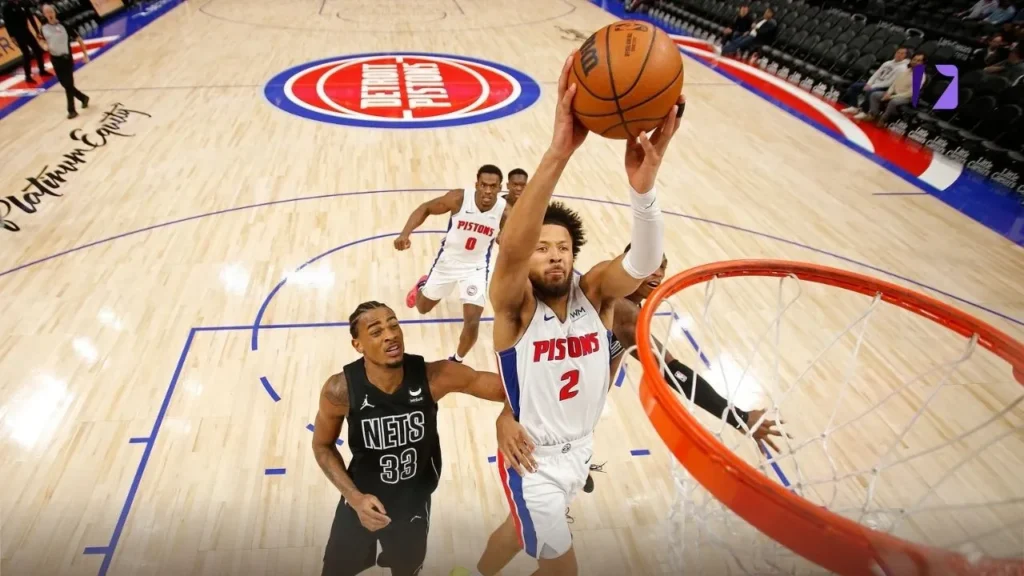
Rebounding proved to be a crucial factor in Detroit’s dominance over Brooklyn. The Pistons collected a total of 40 rebounds, with 10 coming offensively and 30 defensively, compared to Brooklyn’s 31 rebounds (7 offensive, 24 defensive). Detroit’s superior positioning, timing, and physicality allowed them to limit the Nets’ second-chance scoring opportunities. Their dominance on the boards created multiple scoring opportunities while disrupting Brooklyn’s rhythm.
Detroit’s control of the glass also contributed to transition offense. Securing defensive rebounds allowed the Pistons to push the pace, generating 26 fast break points and maintaining consistent offensive pressure. Brooklyn, on the other hand, struggled to recover rebounds and defend the paint effectively, which amplified the Pistons’ scoring advantage. Rebounding clearly illustrated the physical dominance and strategic discipline that Detroit brought to this matchup.
Assist Leaders and Playmaking Comparison
Detroit’s offense benefited immensely from their effective ball movement, leading to 36 total assists for the game. This high number highlights how well the Pistons shared scoring opportunities among teammates. Players like Cade Cunningham and key bench contributors facilitated open shots for multiple scorers, creating a balanced offensive attack that was difficult for Brooklyn to defend.
Brooklyn recorded only 23 assists, reflecting challenges in generating quality looks and maintaining cohesive ball movement. Their offensive system struggled to penetrate Detroit’s defensive coverage, resulting in more contested shots and turnovers. The Pistons’ superior assist-to-turnover ratio underscored their efficiency and teamwork, contrasting sharply with the Nets’ disjointed offensive execution.
Three-Point Shooting Performance
Detroit excelled from beyond the arc, hitting 16 of 31 three-point attempts (52%), which kept defensive attention spread and created open lanes inside the paint. Their consistent perimeter shooting forced Brooklyn defenders to extend coverage, allowing Detroit to exploit mismatches near the basket. This combination of accurate outside shooting and inside dominance made the Pistons’ offense nearly unstoppable.
Brooklyn struggled in comparison, converting only 13 of 38 attempts (34%) from three-point range. Inconsistent perimeter shooting allowed Detroit to focus on interior defense without fear of wide-open shooters. This shooting disparity contributed significantly to the final score gap, highlighting the Pistons’ superior shooting accuracy and strategic offensive planning.
Coaching Strategy and Game Management
Detroit’s coaching staff executed a game plan that capitalized on the team’s strengths and exposed Brooklyn’s weaknesses. Emphasis on fast-paced offense, strong interior play, and aggressive defensive pressure resulted in a highly efficient performance. The Pistons’ rotations ensured that both starters and bench players contributed meaningfully, maintaining high energy throughout the game.
Conversely, Brooklyn’s coaching adjustments struggled to counter Detroit’s offensive and defensive execution. Attempts to increase pace or rely more on perimeter shooting yielded limited results, while defensive rotations often lagged. Detroit’s coaching foresight in exploiting matchups, managing timeouts, and emphasizing ball movement directly contributed to the commanding 138-100 victory.
What This Win Means for the Detroit Pistons Season
The Pistons’ commanding victory over Brooklyn serves as a statement game for the remainder of the season. Dominance in scoring, assists, rebounds, and shooting efficiency demonstrates the team’s cohesion, depth, and offensive versatility. This game may act as a confidence boost, signaling that Detroit is capable of overwhelming opponents with both speed and strategy.
The win also enhances the Pistons’ positioning within their conference standings. Maintaining such performance levels could establish them as strong playoff contenders, especially if they continue to balance efficient scoring with disciplined defense. The game highlights key strengths teamwork, rebounding, and fast break execution that can be leveraged throughout the season.
What the Loss Means for the Brooklyn Nets Moving Forward
For Brooklyn, the 138-100 loss exposes areas in need of urgent improvement. Poor shooting efficiency, high turnovers (19), and struggles in defensive rebounding indicate weaknesses that must be addressed to compete effectively. The game serves as a reminder that perimeter shooting alone is insufficient without interior presence, defensive discipline, and efficient ball movement.
The Nets must work on reducing turnovers, improving rebounding positioning, and diversifying offensive schemes. Enhancing cohesion between starters and bench players is essential. While setbacks are part of any season, the team can use this loss as a learning opportunity to refine strategy and strengthen execution in upcoming matchups.
Conclusion
The March 10, 2026 matchup between the Detroit Pistons and Brooklyn Nets showcased Detroit’s complete dominance across all facets of the game. Efficient shooting, excellent ball movement, fast break execution, and defensive discipline allowed the Pistons to secure a decisive 138-100 win. Key performers like Cade Cunningham and Jalen Duren contributed both scoring and playmaking, while bench depth ensured sustained momentum.
Brooklyn struggled to execute offensively, reflected in poor shooting percentages and turnovers. Detroit’s control over rebounds and defensive pressure highlighted their physical and strategic superiority. Overall, this game emphasized Detroit’s strengths in teamwork, efficiency, and tactical execution, offering a blueprint for continued success in the season ahead.
Frequently Asked Questions
Who were the top scorers for the Detroit Pistons in this game?
Cade Cunningham and Jalen Duren led the Pistons in scoring. Cunningham excelled in playmaking and perimeter shooting, while Duren dominated inside the paint, contributing high-percentage points and rebounds.
How did the Brooklyn Nets perform in terms of shooting efficiency?
The Nets struggled with efficiency, shooting 42% from the field and 34% from three-point range. Poor shot selection and defensive pressure from Detroit limited their scoring opportunities.
What were the key statistical advantages for Detroit?
Detroit dominated in field goal percentage (56%), rebounds (40), assists (36), fast break points (26), and points in the paint (64), showcasing superior execution on both ends of the court.
How did the bench players impact the game?
Detroit’s bench contributed critical scoring bursts, defensive energy, and transition opportunities, helping maintain momentum while starters rested. This depth advantage played a crucial role in the large margin of victory.
What does this game mean for Detroit’s season?
The Pistons’ win reinforces their offensive versatility and defensive discipline, enhancing confidence and positioning in the conference. It demonstrates their potential as playoff contenders if they maintain performance consistency.
VISIT MORE: APEX MAGAZINE