
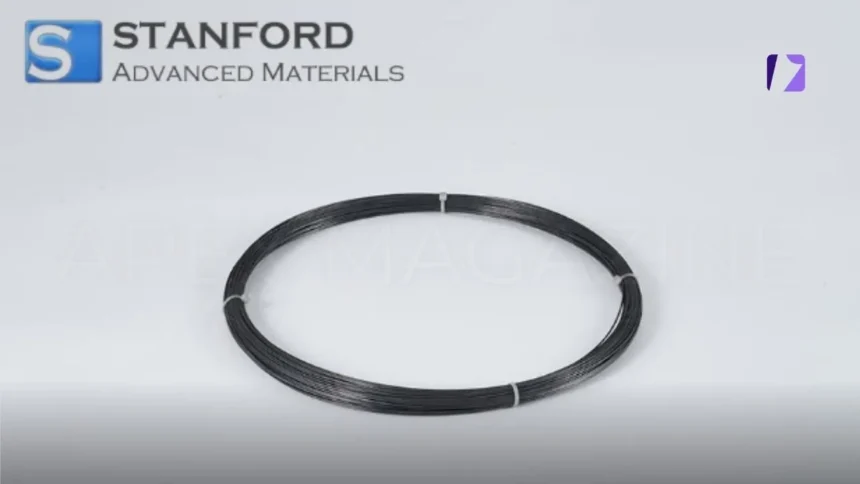
In the world of materials science, most metals, once bent or deformed, are permanently stuck that way. But one alloy completely defies this common sense. Not only can it “remember” its original shape, but it can also magically return to it under specific conditions. That material is Nitinol. From delicate, life-saving medical implants to cutting-edge aerospace technology, Nitinol’s unique “smart” properties are reshaping modern medicine and engineering.
From delicate, life-saving medical implants to cutting-edge aerospace and industrial technologies, Nitinol’s unique properties are transforming modern engineering. It is widely used in cardiovascular stents, orthodontic wires, and surgical tools due to its biocompatibility and corrosion resistance. In engineering, it powers actuators, robotics, and innovative cooling systems through the elastocaloric effect. Although it is significantly more expensive than traditional metals like stainless steel, its durability, flexibility, and long fatigue life make it invaluable in high-performance applications where reliability and precision are absolutely critical.
What Makes Nitinol So Special?
Nitinol is a nearly equal mixture of nickel (Ni) and titanium (Ti). Its name, “Ni-ti-n-o-l,” actually comes from where it was discovered: the Nickel Titanium Naval Ordnance Laboratory. Its two superpowers are the shape memory effect and superelasticity. The shape memory effect means that if you bend or deform Nitinol when it’s cold, simply heating it above a specific “transformation temperature” will make it snap right back to its pre-programmed shape. This “memory” comes from a reversible change in its internal crystal structure. At high temperatures, it exists in a structure called austenite. When it cools, it transforms into a different, more pliable structure called martensite.
Think of heating it as hitting a switch that instantly converts the soft martensite back into the strong, “remembered” austenite. Superelasticity (or pseudoelasticity) is the other side of the coin and it doesn’t need heat. At temperatures above its transformation range, Nitinol can be bent and twisted far more than any ordinary metal (up to 8% strain!) and will instantly snap back to its original shape the moment the force is removed. This happens because the stress itself forces the crystal structure to change, and it reverts as soon as the stress is gone. It’s elasticity on steroids.
What Happens to Nitinol When It Gets Hot?
When you heat a deformed piece of Nitinol, you’re basically waking up its memory. At lower temperatures, it’s in the flexible martensite phase, like a sleeping giant you can easily mold into a new shape.
But as the temperature climbs past its specific transformation point especially the Austenite finish temperature (Af) a microscopic shift happens. The heat triggers a phase transformation. The martensite structure becomes unstable and rapidly reorganizes itself back into the high-temperature austenite structure.
During this process, the atoms precisely snap back to their original positions in the crystal lattice. On a human scale, this looks like the metal forcefully, but smoothly, returning to the shape it was “trained” to remember. Cool it back down, and it’ll go back to martensite, ready for the next time it’s “woken up.”
Where is Nitinol Used?
Thanks to its two main talents shape memory and superelasticity Nitinol is a star player in some pretty high-tech fields.
Biomedical Devices: The Undisputed King
A huge portion of all Nitinol produced (nearly 62%) goes into biomedical applications. Its biocompatibility, corrosion resistance, and unique mechanical properties make it the perfect material for implants.
- Cardiovascular Stents: This is the classic example. A stent is crimped down small while cold, slipped into a catheter, and threaded through blood vessels to a blockage. Once in place and warmed by the body, it expands to its pre-set shape, propping the artery open.
- Dental Archwires: The superelasticity of Nitinol wires provides a gentle, continuous force to move teeth, so patients need fewer adjustments. Plus, temperature changes in the mouth can actually stimulate blood flow in the gums.
- Minimally Invasive Surgery Tools: Guidewires and other instruments made from Nitinol are super flexible and kink-resistant, allowing doctors to navigate tricky paths in the body without causing damage.
Cutting-Edge Engineering & Consumer Goods
- Airless Tires: One company has used Nitinol, based on NASA technology, to create an airless tire called the “Metl.” It combines the flexibility of rubber with the strength of titanium. It’s puncture-proof, durable, and snaps back into shape after deformation, which could also cut down on tire waste.
- Eco-Friendly Refrigerators: Scientists in Germany are tapping into Nitinol’s “elastocaloric effect” the fact that it absorbs and releases heat when stretched and relaxed. They’re using it to develop a new kind of solid-state cooling. This tech would ditch traditional refrigerants and could be over 10 times more energy-efficient than current ACs and fridges, potentially powering everything from EVs to home appliances.
Industrial & Automation
Nitinol is widely used to make things like couplings, actuators, and sensors. For example, in airplane hydraulic systems, a Nitinol tube coupling can be expanded while cold, slipped over the pipes to be joined, and then simply left at room temperature to shrink back and form a super-strong, leak-proof seal—no welding required.
Conclusion
Nitinol is a remarkable material that redefines what metals can do, thanks to its unique shape memory effect and superelasticity. Its ability to return to a pre-set form when exposed to heat or after deformation makes it invaluable in applications where precision, flexibility, and reliability are critical. This “smart” behavior, driven by reversible changes in its internal structure, allows it to perform tasks that traditional metals simply cannot achieve.
From life-saving medical implants to advanced engineering solutions, Nitinol continues to push the boundaries of innovation. Although its high cost and complex manufacturing limit widespread adoption, its unmatched performance ensures its place in specialized fields. As technology evolves, Nitinol is set to play an even greater role in shaping the future of healthcare, sustainability, and high-performance design.
Frequently Asked Questions
Does Nitinol contain nickel? Is it safe for implants?
This is a key question. While Nitinol is about 50% nickel, its surface naturally forms a very stable, protective layer of titanium dioxide (TiO₂) . This layer acts as a shield, preventing nickel ions from leaking out into the body. Studies show its nickel release rate is even lower than standard stainless steel, and surface treatments make it even safer.
Why isn’t Nitinol used everywhere, like stainless steel?
The main hurdles are the high cost and tricky manufacturing. Making Nitinol requires incredibly precise control over the nickel-titanium mix, as tiny changes affect its properties. It’s also difficult to shape and machine, and heat treatment is critical. All this can make it 10 to 50 times more expensive than stainless steel.
How is “superelasticity” different from normal elasticity?
Regular metals have an elastic limit of less than 1%. Bend a paperclip past that point, and it stays bent. Nitinol, however, can recover from 5% to 8% strain. The magic is in the mechanism: normal metals stretch atomic bonds, while Nitinol temporarily transforms its crystal structure under stress to accommodate the bending, then changes right back when the stress is gone.
Does Nitinol’s “memory” wear out?
The memory effect is an intrinsic property and can be used over and over. However, each cycle causes microscopic wear and tear. So, like any material, it has a finite fatigue life. Engineers design for this, ensuring that in applications like stents, it will perform reliably for millions of cycles.
VISIT MORE: APEX MAGAZINE