
At advanced levels, success depends on much more than memorising content. The transition from earlier stages of education requires students to apply knowledge analytically, think critically, and structure answers effectively. Many students know the content well but struggle to translate it into top marks under timed conditions. Exam technique practice bridges this gap, turning knowledge into performance.
Exam technique is the ability to present your understanding clearly, accurately, and efficiently within strict exam conditions. It is a trainable skill, just like writing or problem-solving. Neglecting it can cost students marks, even if they have revised thoroughly. By developing strong exam strategies, students not only improve grades but also gain confidence and reduce stress on exam day.
- Why Exam Technique Makes All the Difference
- What Is Good Exam Technique?
- Practising with Past Papers
- Focusing on Mark Schemes and Examiner Reports
- Time Management: A Skill That Needs Practice
- Common Mistakes Students Make
- Combining Revision with Exam Technique Practice
- Psychological Benefits of Practising Exam Technique
- Additional Tips for Mastering Exam Technique
- Conclusion
- Frequently Asked Questions
- What is exam technique?
- Why is exam technique important for advanced-level students?
- How can I improve my exam technique?
- Are past papers necessary for exam technique practice?
- What role do mark schemes and examiner reports play?
- How can time management be practised for exams?
- Can exam technique reduce anxiety?
Why Exam Technique Makes All the Difference
Examiners in advanced-level exams, such as A-levels, assess not only knowledge but also how well students apply it. Writing correct answers isn’t enough if the response is disorganised, incomplete, or misinterprets the question. Students who practice exam technique learn to read questions carefully, plan answers, and present arguments in a clear, structured manner.
Using resources like Save My Exams can be invaluable. Their exam-style questions and expert-written notes teach students what examiners expect. These materials provide structured practice, helping learners focus on both content and the approach. Over time, repeated practice builds familiarity with question formats and marking schemes, allowing students to tackle exams efficiently.
What Is Good Exam Technique?
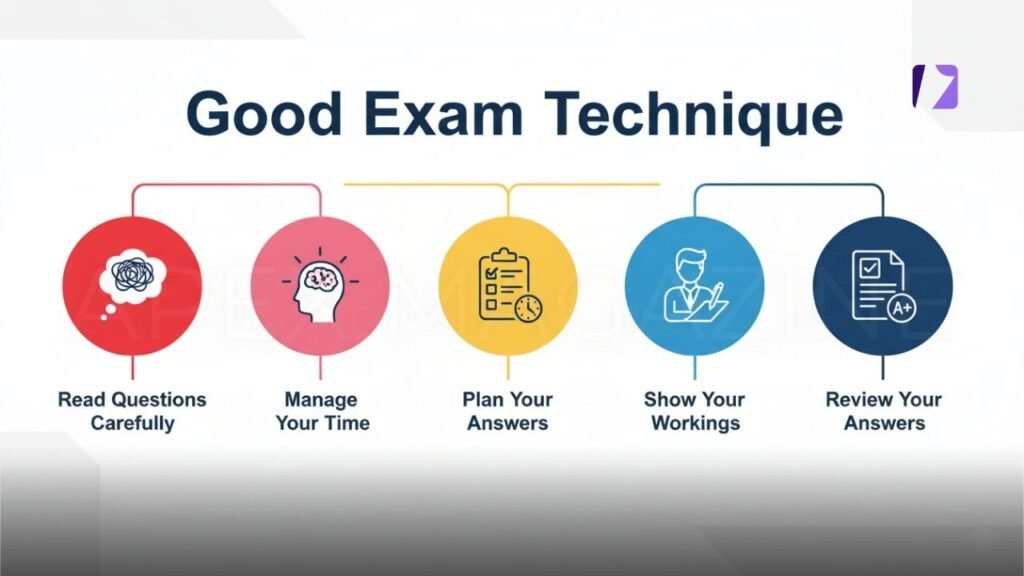
Good exam technique is about strategic habits, not just knowing every detail of the syllabus. It helps students communicate their understanding effectively, even under pressure. Key components include:
- Breaking down questions to answer exactly what is asked.
- Identifying command words such as “explain,” “evaluate,” or “compare,” and tailoring responses accordingly.
- Planning answers for long or essay-style questions to organise ideas.
- Using precise keywords to match examiner expectations.
- Keeping answers concise, ensuring every sentence adds value.
- Prioritising questions based on marks and difficulty.
- Managing time effectively, avoiding spending too long on low-mark questions.
These habits equip students to handle diverse question types calmly and confidently, translating knowledge into marks efficiently.
Practising with Past Papers
Past papers remain one of the most effective tools for mastering exam technique. They replicate real exam conditions, exposing students to timing, question style, and pressure. Regular practice helps learners:
- Spot recurring patterns in question types and topics.
- Identify weak areas early and target them with revision.
- Understand how marks are awarded and the level of detail expected.
- Build familiarity so the real exam feels less intimidating.
Many teachers recommend completing past papers under timed conditions. This highlights weaknesses that normal revision may not reveal, such as slow writing speed, misunderstanding command words, or poor time allocation. Over time, repeated practice enhances accuracy and confidence.
Focusing on Mark Schemes and Examiner Reports
Mark schemes provide insight into how examiners allocate points. By studying them, students learn the precision, structure, and clarity expected in answers. It’s not just about including correct information but presenting it in the right format and style.
Examiner reports are equally valuable, highlighting common mistakes and examples of strong answers. They often reveal pitfalls such as vague explanations or misinterpretation of command words. Analysing these reports allows students to refine their answers and avoid repeated errors, ultimately boosting overall performance.
Time Management: A Skill That Needs Practice
Advanced-level exams are often tightly timed, and even well-prepared students may struggle to complete all questions. Practising technique helps develop an instinctive sense of timing, showing how long to spend on each section and when to move on.
Timed question drills simulate real exam conditions, training students to pace themselves. They learn to prioritise high-mark questions, allocate time for planning and reviewing answers, and reduce the risk of leaving questions incomplete. Over time, this structured approach minimizes stress and increases efficiency.
Common Mistakes Students Make
Even high-achieving students can lose marks due to poor technique. Common errors include:
- Overwriting or adding irrelevant information.
- Misreading command words or answering the wrong question.
- Spending too much time on low-mark questions.
- Writing answers in an unstructured or haphazard manner.
Recognising these pitfalls early allows students to correct habits before the real exam. Regular practice under realistic conditions is the best way to avoid repeating mistakes.
Combining Revision with Exam Technique Practice
Technique practice complements content revision, not replaces it. While revision ensures understanding, technique ensures marks are maximised. A well-rounded study plan integrates both elements:
- Revise key concepts, then answer past paper questions applying those ideas.
- Review mark schemes and examiner feedback after each practice session.
- Adjust techniques based on mistakes, refining timing, structure, and clarity.
This combined approach builds confidence, improves performance, and ensures that hard work during revision translates directly into high scores.
Psychological Benefits of Practising Exam Technique
Beyond improving marks, technique practice reduces exam anxiety. Students who are familiar with timing, question patterns, and planning strategies feel more in control. This calmness improves focus, accuracy, and overall performance.
Practising under realistic conditions also builds mental stamina. Students learn to handle pressure, manage unexpected questions, and maintain clarity throughout the exam. The psychological boost from technique practice is often as significant as the academic advantage.
Additional Tips for Mastering Exam Technique
- Use online resources such as Save My Exams, which provide structured past papers and notes.
- Form study groups to discuss questions and approaches. Explaining answers to others reinforces learning.
- Track progress after each practice session, noting improvements and areas for further work.
- Simulate full exam conditions, including timing, silence, and minimal distractions.
- Reflect on each paper to adapt strategies and avoid repeating mistakes.
These practical steps turn exam technique into a consistent habit that supports long-term success.
Conclusion
Exam technique practice is essential for advanced-level students aiming for strong, reliable results. It bridges the gap between knowledge and performance, improving clarity, confidence, and efficiency under exam conditions.
By combining past paper practice, analysis of mark schemes, and timed drills, students create a structured approach that maximises their performance. Developing these habits early ensures they can tackle high-stakes exams with confidence and achieve their full potential. For ambitious students, making exam technique a core part of revision is one of the simplest yet most powerful steps toward academic success.
Frequently Asked Questions
What is exam technique?
Exam technique is the strategic skill of applying your knowledge effectively under timed conditions. It includes understanding question types, identifying command words, structuring answers, and managing time efficiently to maximise marks.
Why is exam technique important for advanced-level students?
At higher levels, exams assess understanding and application rather than rote memorisation. Strong exam technique ensures students can present ideas clearly, avoid common mistakes, and perform consistently under pressure.
How can I improve my exam technique?
You can improve by practising past papers, reviewing mark schemes, timing your answers, and analysing examiner reports. Focusing on structure, planning, and command words will also enhance your performance.
Are past papers necessary for exam technique practice?
Yes. Past papers simulate real exam conditions, help identify weak areas, and teach students to manage time effectively. They also familiarise students with question formats and examiner expectations.
What role do mark schemes and examiner reports play?
Mark schemes show how points are awarded, helping students understand what constitutes a strong answer. Examiner reports highlight common mistakes and guide students on improving clarity, accuracy, and structure.
How can time management be practised for exams?
Timed drills using past papers are the best method. Allocate specific time to each question, practice prioritising high-mark sections, and simulate exam conditions to develop a natural pace.
Can exam technique reduce anxiety?
Absolutely. Familiarity with timing, question types, and answer planning builds confidence. Practising under realistic conditions helps students stay calm, focused, and efficient during actual exams.
VISIT MORE: APEX MAGAZINE