
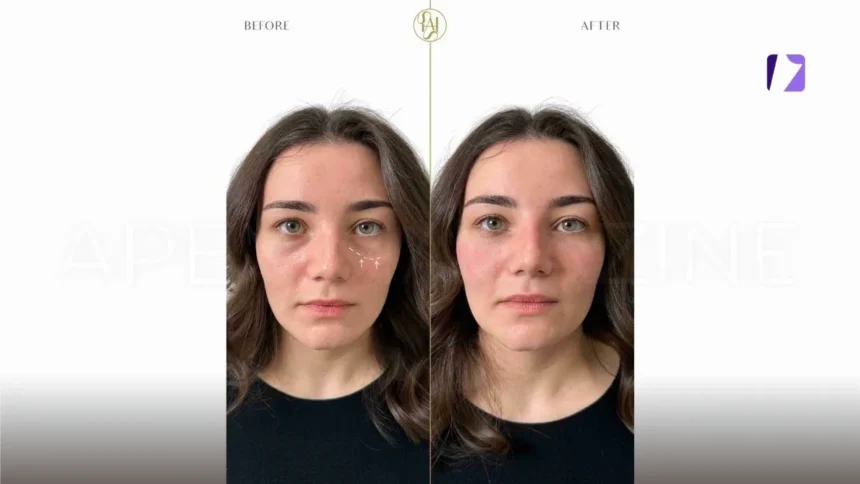
In today’s digital-first world, our faces are on display more than ever. Endless Zoom calls, smartphone selfies, Instagram stories, and TikTok videos expose every expression smile, frown, and yes, age in real time. Where once reflections were fleeting, now they are constant. This hyper-visibility has made us acutely aware of facial features, particularly the under-eye region. What was once dismissed as mere “dark circles” is now understood as a structural element of the face: the tear trough. Its prominence has sparked demand, debate, and new techniques in aesthetic medicine.
Tear trough filler has emerged as one of the most requested and technically demanding treatments in modern clinics. The phenomenon of the “Zoom face” has reshaped patient expectations, encouraging precise, natural-looking interventions. From anatomy to psychology, every element contributes to how under-eye hollows are perceived in the age of high-definition cameras. Understanding this trend requires exploring technology, facial structure, cultural shifts, and medical advancements that intersect to create a new conversation in aesthetic medicine.
- How Cameras Quietly Rewired Our Self-Perception
- The Anatomy of the Tear Trough: What Actually Changes Over Time
- Why Traditional Fixes Like Makeup and Creams Fall Short
- The Solution: How Tear Trough Filler Restores Balance
- The Delicate Art of Precision: Why Expertise Defines Outcomes
- Step-by-Step: What a Treatment Day Looks Like
- Safety and the Shift Toward Doctor-Led Care
- The Psychology: Why Rested Eyes Influence Everything
- Structural Rejuvenation: The Broader Philosophy
- Cultural Context Screens Reshaped Beauty Standards
- Conclusion
- Frequently Asked Questions
How Cameras Quietly Rewired Our Self-Perception
High-definition cameras amplify facial features in ways that distort reality. Smartphone lenses stretch features with wide angles, laptop webcams capture upward angles that deepen shadows, and ring lights create harsh contrasts. Under-eye hollows, or tear troughs, become more pronounced on screen. What appears subtle in natural light may read as fatigue or hollowness on video, prompting heightened concern among users.
The term “Zoom face” emerged early in the pandemic to describe this exact phenomenon. Patients commonly report, “I feel fine in person, but I look exhausted on video calls.” These perceptions are not imagined camera angles, resolution, and lighting combine to exaggerate existing features. Even minor shadows can alter impressions, especially in professional contexts. Skincare and sleep help, but structural support determines how rested and alert the eyes appear.
The Anatomy of the Tear Trough: What Actually Changes Over Time
To understand why tear troughs matter, look at the anatomy. The tear trough isn’t some random wrinkle. It’s a defined boundary where the lower eyelid meets the cheek. In younger faces, this transition stays smooth. Skin sits plump and even. Light glides across the surface without interruption, making eyes look bright and open. Aging disrupts this balance through a series of quiet shifts. Collagen production naturally declines starting in the late 20s. Skin loses its firmness and elasticity. The structural proteins that hold everything in place weaken. Fat pads in the mid-face, which provide volume and support, begin to migrate downward due to gravity and repetitive facial movements. These aren’t dramatic drops. They happen gradually, millimeter by millimeter over years. Ligaments that anchor skin to bone also stretch. The orbital rim, where eye meets cheek, becomes more visible.
What was once a gentle curve turns into a clearer groove. Bone itself resorbs slightly with age, especially in the orbital area, making the hollow more apparent. Skin thins. Volume shifts south toward jowls and nasolabial folds. The tear trough emerges as the visible sign of these changes. The optical effect is powerful. Light no longer reflects evenly. It falls into the depression, creating a shadow. What people perceive as “bags” or “dark circles” often stems from this topography, not pigmentation or vascular issues. Thin skin plays a role, showing underlying muscle or blood flow, but structure drives the shadow. Healthy sleepers with perfect routines still see it because biology evolves regardless. This explains why makeup struggles. Concealers brighten pigment. They can’t fill a void. Layering product often creases into the groove, accentuating texture. Brightening serums hydrate but don’t lift. The fix requires addressing the architecture itself.
Why Traditional Fixes Like Makeup and Creams Fall Short
Generations treated under-eyes as a surface problem. Color-correcting peaches and yellows neutralized blue tones. Thick concealers masked veins. Eye creams promised to thicken skin overnight. These work for mild cases or temporary fatigue. But for structural hollows, they hit limits fast. Heavy makeup settles into the trough, highlighting the dip it aims to hide. Caffeine-infused creams constrict vessels briefly but ignore volume loss. Retinols build collagen slowly, over months or years, with irritation risks.
None rebuild the smooth contour light needs to reflect properly. Patients try everything before clinics. They book facials, invest in gua sha tools, layer hyaluronic acid serums. Results stay superficial. Shadows persist on camera. Frustration builds. That’s when consultations turn to injectables. Aesthetic practitioners reframe the issue: not dermatology, but facial engineering. Structure dictates perception.
The Solution: How Tear Trough Filler Restores Balance
Enter tear trough filler, the gold standard for structural correction. This treatment uses hyaluronic acid (HA), a sugar molecule the body produces naturally to retain moisture and provide cushion. HA fillers mimic this, drawing water to plump targeted areas without rigidity. The process targets precision. Clinicians inject micro-volumes along the trough and sometimes the adjacent cheek. Placement matters immensely. Too superficial, and lumps form under thin skin. Too deep, and support lacks. Ideal spots sit at the bone level or orbital rim, softening the eyelid-cheek junction. One syringe (about 0.3-0.5ml per eye) often suffices. Results appear instantly but refine over two weeks as swelling fades and HA hydrates fully.
Eyes brighten. Shadows lift. The face reads rested, approachable, alive. No one spots the work. They just sense improvement. Longevity varies. Nine to eighteen months typical, influenced by metabolism, activity, and filler brand. Juvederm Volbella or Restylane Silk excel here for their softness and duration. Reversible too, with hyaluronidase enzyme dissolving HA if needed. Safety net included. This subtlety defines modern demand. Patients reject “Instagram face.” They seek enhancement aligning with their features. Brighter eyes enhance without overhaul. It’s why tear trough filler tops charts alongside cheek contouring.

The Delicate Art of Precision: Why Expertise Defines Outcomes
Tear troughs demand mastery. The area spans millimeters. Skin measures 0.5mm thick. Vessels like the angular artery sit perilously close. Poor technique risks bruising, Tyndall effect (bluish tint), or vascular occlusion. Rare but serious. Top practitioners assess holistically. They map bone structure, skin quality, fat distribution. Some decline patients with excess skin or severe hollows, recommending alternatives like blepharoplasty. Others layer cheek filler first, lifting the trough indirectly. Cannulas reduce trauma over needles, gliding filler safely. Micro-droplet technique prevents overfill. Post-care includes ice, avoidance of blood thinners, and follow-ups. Among London aesthetic clinics, Dr Hass Clinic exemplifies this rigor. Dr Hasaneen Al Janabi, GMC-registered and Royal College of Surgeons member, brings surgical precision to injectables. With over 10,000 patients treated, his approach prioritizes anatomy over trends. See their technique in action: Click Here
Step-by-Step: What a Treatment Day Looks Like
Curious about logistics? Here’s the flow. Consultation (15-30 minutes): Doctor evaluates face at rest and movement. Reviews medical history. Discusses goals, suitability. Photographs baseline. Prep (5 minutes): Area cleansed. Topical numbing cream applied 20 minutes prior. Injection (10-15 minutes): Fine cannula or needle delivers filler. Patient upright for real-time assessment. Adjustments live.
Post-care (5 minutes): Ice compresses. Arnica if bruising prone. Care instructions: sleep elevated, no makeup 24 hours, avoid gym 48 hours. Total under 30 minutes. Back to desk same day. Swelling peaks 24-48 hours, fades fast. Results evolve: Day 1 crisp, Week 1 settled, Month 1 optimal. Annual touch-ups maintain.
Safety and the Shift Toward Doctor-Led Care
Accessibility bred risks. Non-doctors rushed treatments. Complications rose. Now patients prioritize medical credentials. GMC registration signals oversight. RCS membership denotes training. Doctor-led clinics assess candidacy rigorously. They integrate ultrasound for vessel mapping. Follow evidence-based protocols. Commercial chains prioritize volume; medical practices prioritize outcomes. This evolution protects patients. It elevates standards. Aesthetic medicine matures toward healthcare.
This shift elevates standards across aesthetic medicine. Patients experience safer procedures, reliable results, and integrated care. Emphasis on credentialed medical professionals ensures longevity and safety, aligning aesthetic medicine more closely with healthcare principles rather than purely cosmetic services. Explore full details Tear Trough Filler at Dr Hass Clinic.
The Psychology: Why Rested Eyes Influence Everything
Dark under-eyes signal fatigue, low energy, or illness subconsciously. On video calls, these cues are magnified. Well-rested, bright eyes convey competence, vitality, and engagement. Patients report increased confidence, improved networking, and better first impressions after structural corrections.
This is more than vanity. In professional and social contexts, perceived alertness affects outcomes. Structural enhancement restores confidence and presence. Tear trough filler improves perception without altering identity, highlighting the intersection of psychology, aesthetics, and modern video-driven communication.
Structural Rejuvenation: The Broader Philosophy
Tear troughs reflect a principle of structural aesthetics: foundation first, details second. Rebuilding cheeks, temples, and jawlines harmonizes facial contours. Isolated fixes often underperform; integrated approaches offer lasting, natural results.
Future trends include collagen bio-stimulators and thread lifts. HA fillers remain the gold standard due to precision, reversibility, and minimal downtime. Patients increasingly favor natural enhancement, avoiding over-corrected appearances. Tear trough treatments exemplify subtle, impactful interventions that optimize facial harmony in the digital age.
Cultural Context Screens Reshaped Beauty Standards
Digital life exposed subtleties. Filters set unrealistic smoothness. Real correction meets halfway. Cultural pivot favors natural enhancement. Celebrities admit fillers. Stigma fades. Tear troughs symbolize this. Small fix, big impact. Tech revealed, medicine solved, society accepted. Ultimately, it’s simple. In screen-dominated lives, looking vibrant matters. Tear trough filler restores contour, confidence, connection. Not perfection. Just you, optimized.
Tear troughs are emblematic: small, precise fixes with significant visual and psychological impact. Technology exposed imperfections, medicine provided solutions, and culture embraced subtle enhancements. Modern aesthetic medicine balances correction with authenticity, meeting patients halfway between reality and expectation.
Conclusion
The Zoom era has transformed how we perceive ourselves and others. Under-eye hollows, once overlooked, now define aesthetic discussions. Tear trough filler offers a safe, precise solution, restoring volume, brightness, and confidence while maintaining a natural appearance.
This treatment exemplifies the fusion of anatomy, psychology, and technology. By addressing structural concerns rather than superficial symptoms, aesthetic medicine elevates both appearance and self-perception. In a screen-dominated world, small interventions create meaningful impact, helping individuals present their best, most alert selves without compromising authenticity.
Frequently Asked Questions
What causes under-eye hollows to appear more prominent on video calls?
Webcams, lighting, and camera angles amplify natural shadows. Wide-angle lenses and overhead lights exaggerate the tear trough, making hollows appear deeper than in natural settings.
Are tear trough fillers safe?
Yes, when administered by qualified practitioners, HA fillers are safe, reversible, and minimally invasive. Expertise and proper technique reduce the risk of bruising or vascular complications.
How long do results last?
Tear trough filler results typically last 9-18 months, depending on metabolism, filler type, and lifestyle factors. Annual touch-ups maintain volume and contour.
Can makeup hide under-eye hollows?
Makeup can temporarily mask pigmentation but cannot fill structural hollows. Concealers may crease into the groove, highlighting depressions rather than correcting them.
Who should perform tear trough filler treatments?
Qualified medical professionals with training in facial anatomy, such as GMC-registered doctors or aesthetic surgeons, ensure safety and optimal outcomes.
VISIT MORE: APEX MAGAZINE