When working in an office, one of the most important tasks that management can address is improving security. Making sure that your office feels like a safe environment for staff is crucial to creating a healthy workplace. That means staying on top of not only the conditions staff work in, but the quality of your entrances and exits. If any door in your office stops locking, for example, make it a priority to replace it. Learning how to change a door lock makes this easier to handle in-house.
Sure, you could call a locksmith to do the job for you. In an office with many doors, though, it might be better to learn how to replace door locks yourself. For expert advice we reached out to tradesmen into how to change a door lock, and this is where Locksandhardware came in. While every lock is different, there is a general process you can follow to replace barrels for door locks in just about every typical office door.
Read on to get additional insight about how to change a door lock before you call a locksmith!
Why Do Offices Need To Change Office Door Locks?
Of course, like any other door, an office door can eventually start to fail. This can happen for all kinds of reasons, but the general reasons include:
- Wear and tear: Over time, even the best door lock barrel will eventually seize up and fail
- Physical damage: the lock might have been damaged in an accident or an incident
- Break-in attempts: locks could fail because someone tried to break into the office
- Staff turnover: when staff move on, it’s good security practice to replace locks
- Lost keys: you might have had staff move on without returning their keys
You might even simply decide that it’s time to upgrade your office doors with new lock cylinder fittings. Or, you might be in the process of upgrading to a new smart security, electronic security and/or master key system. Whatever the reason, though, the process of how to change a door lock remains much the same. Read on for some general advice on how to change the barrel of a lock.
When Should I Call A Locksmith Instead?
Really, there are three main times when it would be better to contact a locksmith:
- You do not feel confident in learning how to replace door lock installations on your own
- You have been the victim of an office break-in/vandalism attempt and want expert help
- You intend to upgrade your office to a new security system that requires professional installation
You can use your best judgment to determine if your current situation is related to the above. However, for the most part, learning how to change a door lock is a good skill to have. Who knows? You might even find that you can use this skill at home or in your personal life away from the office.
How To Change A Door Lock: Replacing The Barrel Of A Lock
It is worth noting that this is a general guide. Many office doors have more specific lock types and thus may need a more particular installation than the above. Additionally, if you wish to install a more complex lock type, such as a digital lock, it is advisable to consult a locksmith.
Generally, though, replacing a door lock means the following steps:
Gather Your Tools
To do this job, you will need just four items. One, a screwdriver – ideally a Phillips, but it’s also good to keep a flathead on hand. You will also need the current key (so you can remove the old lock cylinder barrel) and the replacement barrel (which is the same size as the current lock). Lastly, get a tape measure so you can measure the size of your door lock.
Getting Started
Begin by measuring the current barrel. To do this, open the door fully and then measure from the central screw. You should obtain two measurements from doing so; now, you need to find a new lock barrel that is the same size.
Now, remove the fastening screw that keeps your current lock barrel in place. Turn it counterclockwise and then remove it from the barrel. Keep this screw spare, as you will need it shortly.
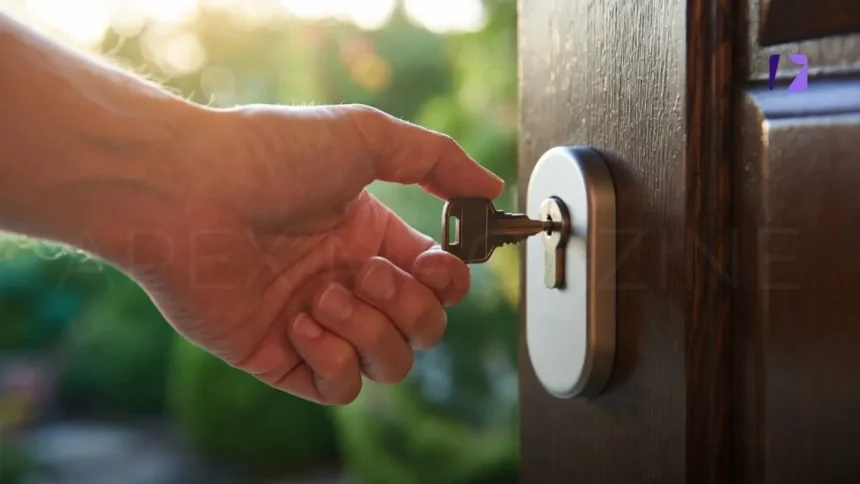
Next, insert the key into your current lock and turn it 10-15 degrees to the left or right. Doing so should loosen the barrel; pull on the barrel, and the old lock cylinder should come out.
Installing The New Lock
Lubricate your new lock with WD-40 to ensure it is primed for installation. Take your new lock and double-check measurements are accurate. If they are, this new lock should slide into the same space that the old lock vacated. When the lock barrel is in place, test it out by turning the barrel with the key inside; it should rotate smoothly without any friction or feedback.
Reattach the fastening screw that you removed earlier, making it a snug, tight fit without being so tight that the lock will not move. Close the door over and open it, and look for any inconsistencies. Try the key in the lock and ensure that everything locks and unlocks smoothly without any issues.
If so, voilà! You have just learned how to change a door lock. Easy, right?
Pro Tip: Set Routine Security Checks & Updates For Office Doors
Now, we hope you can see just how easy it is to replace a lock cylinder. However, we also want to emphasise the importance of proactivity in this context. Do not wait until a problem emerges!
Set a routine schedule for your office maintenance team to check every door and lock in the office. If any lock or door feels like it does not respond as it should, it might be worth investigating the possibility of replacing the lock. Sometimes, a new lock cylinder is all you need to get your doors opening again.
Regular check-ups on every door in your office allow you to spot a problem before it becomes a serious concern. The quicker you can spot the problem, the less likely you are to run into a scenario like an emergency exit gone wrong, or a break-in attempt gone right. Good luck!
Conclusion
Knowing how to change a door lock is a practical skill that can improve office security while reducing maintenance costs. From replacing worn-out lock barrels to upgrading outdated systems, taking a proactive approach helps create a safer and more reliable workplace for staff and visitors alike.
While many standard lock replacements can be handled in-house with the right tools and preparation, there are situations where professional locksmith support is still the best option. The key is understanding when a simple replacement is enough and when a larger security upgrade is necessary.
By carrying out regular security checks and addressing lock issues early, businesses can avoid larger problems down the line and maintain a more secure office environment overall.
Visit More: APEX MAGAZINE