

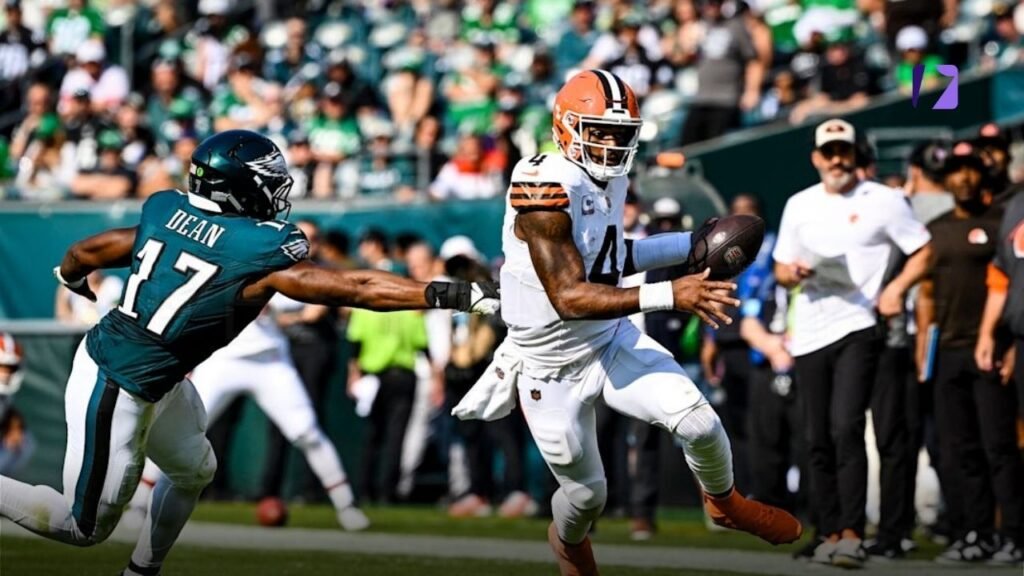
The Cleveland Browns vs Philadelphia Eagles Match secured a 22-13 victory over the Philadelphia Eagles on August 16, 2025, in a game defined by defensive control and time management. Cleveland dominated possession and controlled field position throughout the contest. Their ability to sustain drives and capitalize on opportunities allowed them to overcome mistakes and close the game strongly in the fourth quarter.
Philadelphia showed early resilience in the second quarter, scoring 13 unanswered points to take temporary momentum. However, the Eagles struggled offensively for most of the night, finishing with only 88 total yards. Cleveland’s balanced offense and strong defensive execution ultimately decided the outcome. The final score reflected Cleveland’s consistency rather than explosive playmaking.
- Quick Match Stats Table
- Quick Score Table
- Quarter-by-Quarter Game Breakdown
- Cleveland Browns Key Player Stats
- Browns Quarterback Performance Analysis
- Browns Rushing Leaders and Running Back Impact
- Browns Wide Receivers and Tight Ends Performance
- Browns Defensive Standouts and Sack Leaders
- Philadelphia Eagles Key Player Stats
- Eagles Quarterback Performance Breakdown
- Eagles Running Game and Ground Attack Analysis
- Eagles Wide Receivers and Passing Targets Performance
- Eagles Defensive Highlights and Turnover Impact
- Special Teams Performance from Both Sides
- Top Game-Changing Moments and Turning Points
- Head-to-Head Player Comparisons
- Injury Updates and Their Impact on Player Performance
- Statistical Leaders of the Match
- Key Takeaways from the Cleveland Browns vs Philadelphia Eagles Match
- Conclusion
Quick Match Stats Table
| Category | Cleveland Browns | Philadelphia Eagles |
|---|---|---|
| Total Yards | 331 | 88 |
| Passing Yards | 199 | 55 |
| Rushing Yards | 132 | 33 |
| Turnovers | 2 | 1 |
| Penalties | 6-36 | 5-30 |
| Red Zone Efficiency | 1-3 | 1-1 |
| Time of Possession | 35:57 | 24:03 |

Quick Score Table
| Team | Q1 | Q2 | Q3 | Q4 | Final |
|---|---|---|---|---|---|
| Cleveland Browns | 6 | 6 | 7 | 3 | 22 |
| Philadelphia Eagles | 0 | 13 | 0 | 0 | 13 |
Quarter-by-Quarter Game Breakdown
Cleveland opened the game with steady drives in the first quarter, scoring six points and setting the tone with disciplined offensive play. Their defense forced quick stops and limited the Eagles’ early rhythm. Although they failed to convert touchdowns in the red zone, their field control built pressure on Philadelphia.
The second quarter saw Philadelphia respond with 13 points, capitalizing on a defensive takeaway and improved short-field opportunities. However, Cleveland regrouped in the third quarter with a touchdown drive that shifted momentum back in their favor. A fourth-quarter field goal extended the lead and sealed the 22-13 win. Cleveland’s late-game composure proved decisive.
Cleveland Browns Key Player Stats
Cleveland accumulated 331 total yards, including 199 passing and 132 rushing yards. The offense displayed balance and consistency, spreading production across multiple contributors. Their 35:57 time of possession highlighted strong drive sustainability and effective clock management.
The Browns committed two turnovers, which briefly gave Philadelphia hope. However, Cleveland offset those mistakes with solid third-down execution and disciplined red zone play. Despite going 1-for-3 inside the red zone, they consistently moved the chains and controlled field position throughout the matchup.
Browns Quarterback Performance Analysis
The Browns quarterback delivered an efficient performance, completing high-percentage passes and managing the offense effectively. With 199 passing yards, he distributed the ball strategically and avoided unnecessary risks. His decision-making allowed Cleveland to maintain long drives and protect the lead in key moments.
Although he did not produce explosive plays, his command at the line of scrimmage stood out. He adjusted protections, read defensive alignments accurately, and converted crucial third downs. His composure in the second half ensured the Browns regained control after Philadelphia’s second-quarter surge.
Browns Rushing Leaders and Running Back Impact
Cleveland’s rushing attack generated 132 yards, creating balance and keeping the Eagles defense off guard. The running backs executed inside zone plays effectively and attacked gaps with confidence. Their physicality wore down the Eagles’ defensive front over time.
The ground game also played a critical role in time management. Sustained rushing drives in the third and fourth quarters drained the clock and limited Philadelphia’s opportunities. By maintaining steady production on the ground, Cleveland prevented defensive substitutions and controlled the game’s tempo.
Browns Wide Receivers and Tight Ends Performance
The Browns’ receiving corps contributed consistently to the passing total of 199 yards. Short and intermediate routes moved the chains and kept the offense ahead of schedule. Receivers displayed strong route discipline and secured contested catches when necessary.
Tight ends played a vital role in both blocking and receiving. Their ability to create mismatches over the middle provided the quarterback with reliable safety valves. This balanced contribution from wideouts and tight ends strengthened Cleveland’s offensive structure.
Browns Defensive Standouts and Sack Leaders
Cleveland’s defense dominated statistically, holding the Eagles to just 88 total yards. Their pass rush disrupted Philadelphia’s rhythm and forced hurried throws. The defensive line maintained gap discipline and limited rushing lanes throughout the game.
Linebackers and defensive backs executed strong coverage schemes, closing space quickly and preventing explosive plays. Although the Browns forced only one turnover, they consistently pressured the Eagles into stalled drives. Their defensive discipline shaped the overall result.
Philadelphia Eagles Key Player Stats
The Eagles finished with only 55 passing yards and 33 rushing yards. Offensive struggles limited their ability to sustain drives. Despite scoring 13 points in the second quarter, they failed to generate consistent production afterward.
Philadelphia committed one turnover and struggled with field position. Their red zone efficiency stood at 1-for-1, but limited opportunities prevented them from adding more points. The offense lacked rhythm and faced constant defensive pressure.
Eagles Quarterback Performance Breakdown
The Eagles quarterback faced relentless pressure and completed limited yardage. With only 55 passing yards, he struggled to establish timing with his receivers. Defensive coverage restricted passing windows and forced conservative decisions.
Despite a brief spark in the second quarter, he could not sustain momentum. Protection breakdowns and tight coverage disrupted play execution. His limited yardage reflected Cleveland’s strong defensive game plan.
Eagles Running Game and Ground Attack Analysis
Philadelphia’s rushing attack managed only 33 yards. Cleveland’s defensive front closed running lanes quickly and tackled effectively in open space. Running backs found little room to accelerate.
Without a reliable ground game, the Eagles offense became predictable. This allowed Cleveland’s defense to focus on coverage schemes and pressure packages. The lack of rushing balance severely impacted Philadelphia’s offensive flexibility.
Eagles Wide Receivers and Passing Targets Performance
Philadelphia’s receivers struggled to separate from coverage. Limited passing attempts and tight defensive schemes reduced opportunities for big plays. Short completions failed to generate significant yards after catch.
Receivers showed effort and discipline but lacked rhythm with the quarterback. The Browns’ secondary maintained tight alignment and disrupted routes effectively. This containment strategy minimized explosive potential.
Eagles Defensive Highlights and Turnover Impact
Philadelphia’s defense showed resilience, especially in the second quarter. They capitalized on a Cleveland turnover and created scoring momentum. Their red zone defense also limited touchdowns, forcing field goal attempts.
However, extended time on the field weakened defensive stamina. Cleveland’s 35:57 possession time gradually wore them down. While they recorded one takeaway, they could not consistently halt long drives.
Special Teams Performance from Both Sides
Special teams played a subtle but important role in field position. Cleveland’s kicking unit contributed crucial points, especially in early quarters. Accurate field goal attempts helped maintain scoreboard pressure.
Philadelphia’s special teams executed solid coverage but lacked impactful returns. Field position often favored Cleveland due to sustained drives and strategic punting decisions. These hidden-yardage factors influenced the outcome.
Top Game-Changing Moments and Turning Points
The third-quarter touchdown by Cleveland completely shifted the rhythm of the game. After allowing 13 points in the second quarter, the Browns needed a composed response, and they delivered with a structured, clock-consuming drive. That possession blended short, high-percentage passes with steady rushing gains, wearing down the Eagles’ defensive front. The touchdown not only restored the lead but also re-established Cleveland’s physical identity. It forced Philadelphia to abandon balance and chase the game.
Another defining moment arrived in the fourth quarter when Cleveland added a crucial field goal to stretch the lead to two possessions. That kick increased scoreboard pressure and limited Philadelphia’s play-calling flexibility. From that point, the Browns leaned heavily on their ground game and defensive containment strategy. A late defensive stop, fueled by tight coverage and disciplined tackling, prevented any comeback attempt. Cleveland’s ability to execute in these high-leverage situations ultimately secured the 22-13 victory.
Head-to-Head Player Comparisons
The quarterback battle clearly favored Cleveland in both production and control. With 199 passing yards compared to Philadelphia’s 55, the Browns’ signal-caller dictated tempo throughout the game. He delivered consistent throws in short and intermediate windows, moved the chains efficiently, and avoided unnecessary risks. Meanwhile, the Eagles’ quarterback faced relentless pressure and struggled to find rhythm. The stark yardage difference reflected Cleveland’s superior execution and protection schemes.
The rushing comparison further emphasized the gap between the two teams. Cleveland generated 132 rushing yards, maintaining offensive balance and extending drives. Philadelphia managed only 33 rushing yards, which limited their ability to sustain possessions. This imbalance allowed the Browns’ defense to anticipate passing scenarios and apply focused pressure. In overall team performance, Cleveland’s defense also dominated by allowing just 88 total yards. The numbers underline a decisive advantage in preparation and execution.
Injury Updates and Their Impact on Player Performance
No major injuries shaped the outcome of the contest, but in-game rotations influenced certain matchups. Both teams adjusted personnel packages strategically, especially along the defensive line and at skill positions. Cleveland managed substitutions efficiently, which preserved energy and maintained execution levels late in the game. Philadelphia rotated defenders frequently in an attempt to counter extended drives. However, those adjustments did not significantly shift momentum.
Fatigue became more noticeable for the Eagles’ defense as the game progressed. Cleveland’s 35:57 time of possession kept Philadelphia on the field for extended stretches. Long drives created physical strain and reduced late-game explosiveness. Tackling angles widened, and pursuit speed declined in critical moments. Cleveland capitalized by maintaining a run-heavy approach in the fourth quarter. While injuries did not dominate headlines, stamina and depth played a subtle but important role in the final result.
Statistical Leaders of the Match
Cleveland’s quarterback led all passers with 199 yards, demonstrating command and composure under pressure. His distribution of the football across multiple targets prevented defensive predictability. The Browns’ leading rusher powered the ground attack, contributing significantly to the 132-yard team total. On defense, Cleveland’s front seven controlled the line of scrimmage and restricted Philadelphia to only 88 total yards. These performances formed the backbone of the victory.
Philadelphia’s statistical leaders faced a challenging environment. While they converted their lone red zone opportunity, overall production remained limited. The quarterback managed 55 passing yards, and the rushing unit combined for just 33 yards. Defensive contributors showed flashes during the second quarter surge, including forcing a turnover. However, the broader statistical landscape highlighted Cleveland’s dominance in yardage, possession, and efficiency.
Key Takeaways from the Cleveland Browns vs Philadelphia Eagles Match
Cleveland’s victory resulted from strategic balance and disciplined execution. The Browns combined 199 passing yards with 132 rushing yards, creating unpredictability in play-calling. Their nearly 36 minutes of possession time demonstrated effective clock control and situational awareness. Even with two turnovers, they maintained structural stability and responded quickly to adversity. Defensive consistency limited explosive plays and forced Philadelphia into uncomfortable scenarios.
Philadelphia displayed competitive resilience, especially during their 13-point second quarter. However, inconsistency on offense and limited yardage production hindered sustained momentum. The inability to establish a strong running game restricted their options late in the contest. Defensive fatigue compounded those struggles as the game progressed. Ultimately, Cleveland’s efficiency, preparation, and physicality shaped the 22-13 outcome and underscored their tactical superiority.
Conclusion
The Cleveland Browns vs Philadelphia Eagles Match Player Stats from August 16, 2025, illustrate how balanced offense and defensive discipline determine outcomes in tightly contested games. Cleveland’s 331 total yards, dominant time of possession, and effective rushing attack created measurable advantages. Philadelphia capitalized on limited opportunities but struggled to maintain rhythm across four quarters.
This 22-13 result reflects Cleveland’s composure under pressure and strategic adaptability. Their ability to control tempo, manage field position, and execute in critical moments proved decisive. As both teams evaluate this matchup, the statistical contrast offers clear insight into what separated victory from defeat.
Frequently Asked Questions
Who won the Cleveland Browns vs Philadelphia Eagles match on August 16, 2025?
The Cleveland Browns won the game with a final score of 22-13.
How many total yards did the Browns record?
Cleveland recorded 331 total yards, including 199 passing and 132 rushing yards.
How many yards did the Eagles gain in the match?
Philadelphia gained 88 total yards, with 55 passing and 33 rushing yards.
What was the biggest factor in Cleveland’s win?
Time of possession and defensive dominance were the biggest factors, as Cleveland controlled the ball for nearly 36 minutes.
How efficient were both teams in the red zone?
Cleveland went 1-for-3 in the red zone, while Philadelphia converted their only red zone opportunity.
VISIT MORE: APEX MAGAZINE