
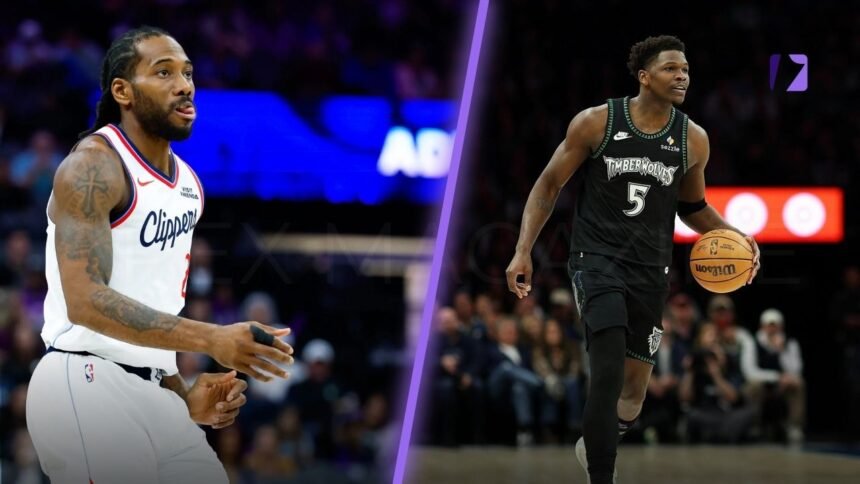
On 9 February 2026, the LA Clippers clashed with the Minnesota Timberwolves in a high-stakes Western Conference matchup. Both teams came into the game with strong rosters and ambitions to solidify their standings. The Clippers aimed to maintain consistency and capitalize on home-court advantages, while the Timberwolves sought to assert themselves against a top-tier opponent. Fans and analysts anticipated a fast-paced game featuring standout scoring, defensive intensity, and strategic coaching adjustments.
The matchup promised star performances, with Kawhi Leonard leading the Clippers and Anthony Edwards spearheading Minnesota’s attack. From the opening tip, it was clear that both teams were focused on establishing control and executing their game plans efficiently. The game became a showcase of NBA talent, combining individual brilliance with cohesive team play, and demonstrated why both franchises are competitive forces in the league.
- Quick Score Summary Table
- Quick Match Overview
- Quick Match Stats Overview
- LA Clippers vs Timberwolves: Game Summary
- Key Player Performances
- Top Scorers and Playmakers
- Defensive Highlights and Key Stops
- Team Comparisons and Statistical Analysis
- Game Highlights and Key Moments
- Post-Match Reactions
- Implications for Standings and Next Games
- Conclusion
- Frequently Asked Questions
Quick Score Summary Table
| Team | 1 | 2 | 3 | 4 | Final |
|---|---|---|---|---|---|
| LA Clippers | 23 | 31 | 26 | 35 | 115 |
| Timberwolves | 19 | 23 | 17 | 37 | 96 |
Quick Match Overview
The Clippers dominated the Timberwolves 115–96, controlling the game through precise shooting, disciplined defense, and balanced contributions across the roster. Each quarter reflected LA’s strategic execution, as they led in scoring in three out of four quarters. Minnesota struggled to match the Clippers’ offensive rhythm and high field-goal percentage, particularly from beyond the arc, which ultimately widened the margin.
Key moments included the Clippers’ early runs and ability to convert fast-break opportunities efficiently. With 28 points as their largest lead, LA controlled the tempo and restricted Minnesota’s scoring in crucial stretches. The game demonstrated the importance of both offensive efficiency and defensive awareness, with the Clippers leveraging both to secure a convincing victory.
Quick Match Stats Overview
| Category | LA Clippers | Timberwolves |
|---|---|---|
| FG | 39-76 | 37-83 |
| Field Goal % | 51 | 45 |
| 3PT | 14-27 | 8-33 |
| Three Point % | 52 | 24 |
| FT | 23-28 | 14-22 |
| Free Throw % | 82 | 64 |
| Rebounds | 37 | 41 |
| Offensive Rebounds | 8 | 10 |
| Defensive Rebounds | 29 | 31 |
| Assists | 25 | 17 |
| Steals | 11 | 8 |
| Blocks | 6 | 2 |
| Total Turnovers | 15 | 21 |
| Points Conceded Off Turnovers | 18 | 25 |
| Fast Break Points | 17 | 19 |
| Points in Paint | 40 | 56 |
| Fouls | 21 | 22 |
| Technical Fouls | 2 | 1 |
| Flagrant Fouls | 0 | 0 |
| Largest Lead | 28 | 3 |
| Percent Led | 89 | 4 |
LA Clippers vs Timberwolves: Game Summary
The first quarter set the tone for an intense matchup between the Los Angeles Clippers and the Minnesota Timberwolves. The Clippers jumped to an early 23–19 lead, showcasing sharp field-goal precision and consistent three-point shooting. Their guards orchestrated plays efficiently, creating open looks for shooters while maintaining control over turnovers. Defensively, LA rotated effectively, limiting Minnesota’s opportunities in the paint and forcing contested perimeter shots, which kept the Timberwolves from establishing offensive rhythm. This early lead provided the Clippers with momentum that proved critical in the subsequent quarters.
In the second quarter, Minnesota attempted to close the gap with aggressive drives and timely perimeter shots. However, the Clippers’ cohesive team movement and unselfish ball distribution prevented the Timberwolves from gaining significant traction. After halftime, LA expanded the lead by exploiting turnovers and converting fast-break opportunities. Their defensive discipline and consistent shooting allowed them to control the pace of the game, ultimately finishing with a dominant 115–96 victory. The game highlighted the Clippers’ ability to balance offense and defense while executing a strategy that neutralized Minnesota’s star talent.
Key Player Performances
Kawhi Leonard emerged as the standout performer for the Clippers, scoring an impressive 41 points, collecting 8 rebounds, and recording 6 assists. His ability to hit mid-range jumpers and perimeter shots consistently forced Minnesota defenders to collapse, opening opportunities for teammates. Leonard’s scoring under pressure and his vision for creating plays underscored his dual impact as both a scorer and facilitator. His leadership on the court elevated the Clippers’ overall performance and set the standard for efficiency and composure during the game.
For the Timberwolves, Anthony Edwards led the team with 23 points, displaying strong driving ability and keen court awareness. Despite Minnesota’s loss, Edwards’ performance emphasized his role as a primary scoring threat and demonstrated his capacity to make plays in critical moments. Clippers’ K. Dunn also contributed significantly with 6 assists and 1 steal, guiding ball movement and maintaining floor balance. These individual performances revealed the importance of star players in influencing game dynamics, though team execution ultimately determined the outcome.
Top Scorers and Playmakers
Kawhi Leonard topped the scoring charts with 41 points, blending mid-range accuracy with perimeter shooting to dominate LA’s offense. Supporting him, Paul George and Marcus Morris contributed crucial scoring bursts that prevented Minnesota from regaining control. K. Dunn’s floor leadership facilitated 25 team assists, ensuring efficient ball movement and the creation of high-percentage opportunities. The Clippers’ balanced approach and collaborative playmaking allowed them to sustain offensive momentum throughout the game.
For Minnesota, Anthony Edwards was both a scorer and playmaker, contributing 23 points and 3 assists. Rudy Gobert added interior presence with rebounds and points in the paint, anchoring Minnesota’s efforts on both ends. Despite these individual contributions, the Timberwolves were unable to match the Clippers’ offensive depth and execution. The game reinforced the idea that while star performances are valuable, collective teamwork and strategic play often dictate success in NBA contests.
Defensive Highlights and Key Stops
The Clippers’ defensive performance was a cornerstone of their 115–96 victory over the Timberwolves. They recorded 11 steals and 6 blocks, disrupting Minnesota’s offensive rhythm throughout the game. Strategic rotations, strong help defense, and effective communication allowed LA to contest shots and control the paint. By denying easy scoring opportunities and forcing difficult attempts, the Clippers created multiple fast-break chances, turning defensive stops into offensive points. This defensive intensity set the tone early and kept Minnesota from establishing momentum.
Minnesota had moments of defensive success, particularly with Rudy Gobert patrolling the rim and Jaden McDaniels contributing 2 steals. However, the Timberwolves struggled to contain LA’s perimeter shooting and allowed 40 points in the paint. Their rotations were slower, and gaps in help defense created open looks for Clippers shooters. The defensive imbalance ultimately determined the game’s outcome, showing that LA’s structured and disciplined defensive strategy could neutralize Minnesota’s best offensive threats while generating scoring opportunities on the other end.
Team Comparisons and Statistical Analysis
The Clippers outperformed Minnesota across nearly every major statistical category, showcasing both efficiency and depth. LA shot 51% from the field, including a remarkable 52% from beyond the arc, compared to Minnesota’s 45% overall shooting and just 24% from three-point range. Free-throw efficiency further highlighted the gap, with the Clippers converting 82% of attempts versus 64% for the Timberwolves. This scoring consistency allowed LA to maintain control throughout the game and capitalize on key possessions.
Turnovers and points off turnovers further emphasized the Clippers’ advantage. LA committed 15 turnovers, leading to 18 points for Minnesota, while Minnesota’s 21 turnovers generated 25 points for LA. Fast-break points (17–19) and points in the paint (56–40) demonstrated the Clippers’ dominance in transition and interior play. Collectively, these statistics illustrate that LA’s combination of shooting efficiency, ball control, and defensive execution was critical to securing a decisive victory over a talented Timberwolves squad.
Game Highlights and Key Moments
The Clippers’ largest lead of 28 points in the second half showcased their offensive dominance and defensive discipline. Kawhi Leonard’s scoring runs kept Minnesota off balance, while Paul George’s perimeter shooting extended the lead and energized the team. Each quarter featured moments of sustained intensity, with LA’s ability to convert fast-break opportunities and execute set plays efficiently contributing to a steady scoreboard advantage. The Clippers’ ability to control tempo and maintain composure allowed them to stay ahead even when the Timberwolves applied pressure.
Minnesota attempted several comebacks, largely led by Anthony Edwards’ drives and mid-range shooting. Key moments included contested fast-break points, defensive stops, and clutch baskets that briefly narrowed the gap. Despite these efforts, LA’s consistent execution in both offensive and defensive phases prevented any significant momentum swing. Ultimately, the Clippers’ ability to control pace, convert high-percentage shots, and sustain defensive pressure ensured a decisive victory, emphasizing the team’s balance and strategic discipline in high-stakes NBA matchups.
Post-Match Reactions
Clippers’ coach praised the team’s execution, emphasizing both offensive efficiency and defensive discipline. He highlighted Kawhi Leonard’s leadership on the court, noting how his scoring and defensive presence set the tone for the team. Players expressed confidence in sustaining momentum through upcoming games, stressing teamwork, communication, and the importance of sticking to game plans. Analysts also highlighted the Clippers’ dominance in shooting percentages, effective ball movement, and well-coordinated defensive rotations as key factors behind their decisive win.
For the Timberwolves, post-game reflections focused on areas of improvement. Players acknowledged struggles in perimeter shooting and the impact of turnovers on the game’s outcome. Anthony Edwards stressed the need for better execution and resilience against elite teams. Despite the loss, Minnesota’s squad identified valuable lessons, highlighting individual growth opportunities and strategies for enhancing team cohesion. Analysts suggested these insights could help the Timberwolves improve consistency in future matchups and remain competitive in the Western Conference.
Implications for Standings and Next Games
The Clippers’ 115–96 victory strengthened their standing in the Western Conference, reinforcing their reputation as a top-tier team capable of dominating quality opponents. The win demonstrated their ability to combine star power with collective execution, a crucial factor for upcoming games against playoff contenders. Maintaining shooting efficiency and defensive intensity will be essential for LA to continue its upward trajectory, especially in close contests where execution can decide outcomes.
For Minnesota, the game highlighted the importance of addressing weaknesses to remain competitive. Improving three-point accuracy, reducing turnovers, and tightening defensive rotations will be key focus areas in future matchups. Analysts predict that strategic adjustments, player development, and learning from experiences like this Clippers game will be critical for the Timberwolves as they aim to challenge stronger Western Conference teams.
Conclusion
The LA Clippers vs Timberwolves matchup on 9 February 2026 showcased the critical balance between offensive execution, shooting efficiency, and defensive coordination. LA’s 115–96 win was defined by Kawhi Leonard’s standout performance and timely contributions from supporting players, emphasizing how individual brilliance and team cohesion intersect to secure victories. Minnesota displayed flashes of talent, particularly from Anthony Edwards and Rudy Gobert, but could not match the Clippers’ execution across all phases of the game.
This contest illustrated that strategic planning, star performances, and collective discipline ultimately shape NBA outcomes. Fans witnessed high-level basketball action, with both offensive creativity and defensive intensity on display. The game reinforced the competitive nature of the Western Conference and highlighted the importance of sustained effort, precise execution, and team synergy in achieving success over elite opponents.
Frequently Asked Questions
Who were the top scorers in the LA Clippers vs Timberwolves game?
Kawhi Leonard led the Clippers with 41 points, while Anthony Edwards led the Timberwolves with 23 points.
What was the final score of the game?
The LA Clippers defeated the Minnesota Timberwolves 115–96 on 9 February 2026.
Which team had more rebounds?
The Timberwolves had slightly more rebounds (41) than the Clippers (37), but the Clippers’ efficiency in scoring turned the difference in their favor.
How did three-point shooting impact the game?
The Clippers’ 52% three-point shooting compared to Minnesota’s 24% was a key factor in establishing and maintaining their lead.
Who made the most assists?
The Clippers recorded 25 assists, led by K. Dunn with 6, highlighting their effective ball movement and teamwork.
VISIT MORE: APEX MAGAZINE