
In today’s rapidly evolving technological landscape, AI agents have become central to the transformation of business processes, decision-making, and operational efficiency. An AI agent is a software entity capable of perceiving its environment, processing data, and taking actions to achieve specific objectives. Unlike traditional automation tools, AI agents learn, adapt, and improve over time, making them critical in applications ranging from customer service to predictive analytics. Businesses are increasingly relying on intelligent automation to reduce costs, improve accuracy, and enhance strategic decision-making, creating a growing demand for professionals who understand these systems.
Intelligent automation powered by AI agents is not limited to large enterprises. Small and medium-sized businesses are also leveraging these technologies to optimize workflows, streamline repetitive tasks, and enhance customer engagement. By combining AI algorithms with process automation, organizations can unlock unprecedented efficiency and agility. Understanding the mechanics, applications, and challenges of AI agents is essential for anyone seeking to implement these solutions successfully. This article explores every aspect of AI agents, from basic definitions to advanced applications, ensuring a comprehensive view of their impact and potential.
- What is an AI Agent?
- Types of AI Agents
- How AI Agents Work
- Applications of AI Agents in Business
- Benefits of Using AI Agents
- Challenges and Limitations
- AI Agents vs. Intelligent Automation
- Key Technologies Behind AI Agents
- Future of AI Agents
- Best Practices for Implementing AI Agents
- Case Studies of Successful AI Agent Deployment
- Conclusion
- Frequently Asked Questions
What is an AI Agent?
An AI agent is a software entity designed to perceive its environment, make decisions, and perform tasks autonomously or semi-autonomously. These agents process input from their surroundings, analyze data, and execute actions to achieve a predefined goal. Unlike traditional programs, AI agents are adaptive, meaning they can learn from past experiences and improve over time. This capability allows them to respond dynamically to complex situations, making them suitable for unpredictable environments. AI agents can operate independently or as part of larger intelligent systems, often interacting with humans, machines, and other software components to optimize performance.
Core components of an AI agent typically include sensors or data input mechanisms, a reasoning or decision-making engine, and actuators or output mechanisms to perform tasks. Some agents also incorporate learning modules, enabling them to improve based on feedback or experience. Examples of AI agents include chatbots that handle customer queries, recommendation engines that personalize content, and autonomous vehicles that navigate environments without human intervention. Their versatility and adaptability make AI agents a cornerstone of modern intelligent automation strategies across industries.
Types of AI Agents
AI agents can be classified into several types based on their behavior and capabilities. Reactive agents operate in real-time and respond to environmental stimuli without relying on past experience. These agents are simple but effective for straightforward tasks where history is less relevant. Goal-based agents go a step further by considering future outcomes and planning actions to achieve specific objectives. Utility-based agents enhance this approach by evaluating different actions based on a utility function, selecting options that maximize overall benefit.
Learning agents represent the most advanced category, capable of acquiring knowledge from past interactions to improve performance over time. These agents use techniques such as reinforcement learning, supervised learning, or unsupervised learning to adapt their decision-making processes. The classification of AI agents is essential for businesses, as selecting the right type depends on task complexity, environmental variability, and organizational objectives. Understanding these types allows for targeted implementation of AI solutions that provide measurable benefits.
How AI Agents Work
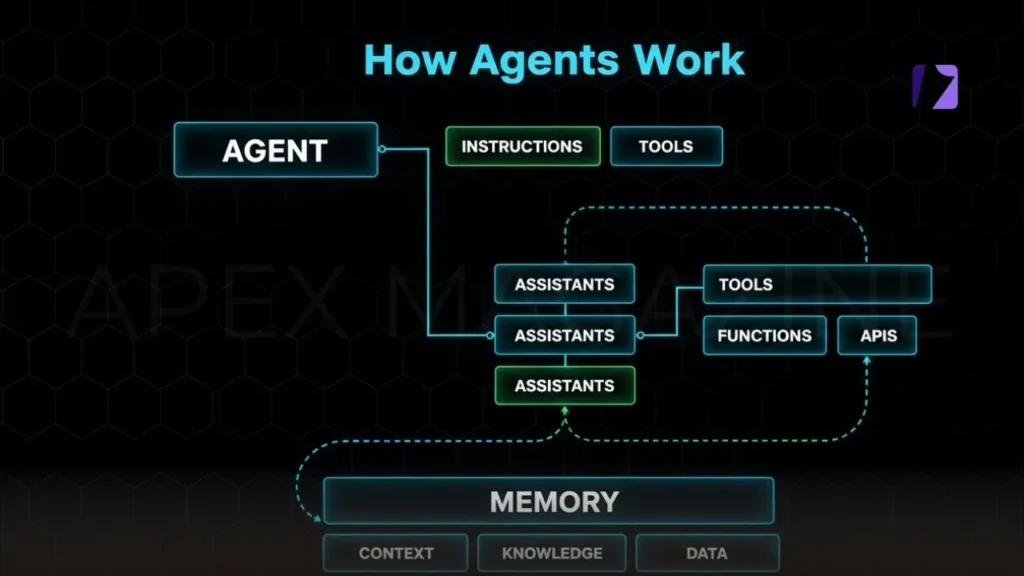
AI agents operate through a combination of perception, reasoning, and action. Perception involves collecting data from the environment using sensors or input streams such as cameras, microphones, or digital databases. This data is then processed using algorithms that analyze patterns, identify trends, and extract relevant information. The reasoning component evaluates possible actions based on predefined rules, goals, or learned behavior. Finally, the agent executes decisions through actuators or digital outputs, creating measurable impact in its environment.
Many AI agents also incorporate feedback loops, allowing them to refine decisions based on outcomes. For example, a customer support chatbot might adapt its responses by analyzing which solutions led to successful query resolution. Machine learning models, natural language processing, and predictive analytics are often integrated into AI agents to enhance decision accuracy and responsiveness. By continuously learning and adjusting, AI agents provide intelligent automation that grows more effective over time, making them invaluable in dynamic, real-world environments.
Applications of AI Agents in Business
AI agents are revolutionizing modern businesses by automating intricate processes that were once time-consuming and prone to human error. In finance, AI agents identify fraudulent transactions in real-time, analyze market trends, and assist in portfolio management with precision, reducing the risk of loss. Healthcare leverages AI for predictive diagnostics, patient monitoring, and administrative workflows, minimizing errors and optimizing operational efficiency. Retail companies use AI agents to personalize recommendations, streamline inventory management, and automate customer support, ensuring a seamless shopping experience. These applications demonstrate how AI agents enhance operational effectiveness and strategic decision-making.
In addition to core industries, AI agents improve customer service and manufacturing processes. Virtual assistants and chatbots handle inquiries around the clock, providing instant responses and freeing human staff for complex interactions. Manufacturing sectors deploy AI for predictive maintenance, quality assurance, and supply chain optimization, reducing downtime and production losses. By analyzing large volumes of real-time data, AI agents help businesses respond rapidly to market changes and anticipate future trends. Their adaptability and learning capabilities make them invaluable in dynamic environments, positioning AI agents as a central element in enterprise digital transformation strategies.
Benefits of Using AI Agents
One of the primary advantages of AI agents is their ability to automate repetitive tasks, allowing employees to focus on strategic and creative work. Automation reduces errors, ensures consistent quality, and accelerates operational workflows. AI agents also analyze massive datasets quickly, delivering actionable insights that support data-driven decision-making. By responding to changing conditions proactively, businesses can maintain competitiveness and enhance customer satisfaction. These benefits create measurable ROI, demonstrating that AI agents are not just operational tools but strategic assets that improve performance, efficiency, and profitability across sectors.
Scalability and personalization are additional benefits of AI agents. They can handle high volumes of tasks simultaneously without fatigue, making them ideal for large-scale operations. AI agents can also tailor communications, recommendations, and services to individual customers, improving engagement and loyalty. Businesses that implement AI agents experience cost reductions, efficiency gains, and improved customer experiences. As AI technologies advance, these benefits expand further, enabling companies to innovate rapidly and adapt to new challenges. Leveraging AI agents effectively is now essential for maintaining a competitive edge in today’s fast-paced markets.
Challenges and Limitations
Despite their transformative potential, AI agents face several challenges that organizations must address. A primary issue is data quality and availability. AI agents rely on accurate, comprehensive datasets to make decisions effectively. Incomplete or biased data can result in flawed outputs, perpetuating errors or unfair outcomes. Additionally, the cost of developing and maintaining AI agents can be high. Companies need skilled personnel, robust computing infrastructure, and continuous monitoring to ensure agents operate reliably and efficiently. Failure to address these factors can compromise performance and reduce the value of AI implementations.
Ethical concerns further complicate AI agent deployment. Issues of privacy, accountability, and transparency are particularly significant when AI makes decisions affecting people or sensitive operations. Some AI agents operate as “black boxes,” producing results that are difficult to interpret or explain, posing regulatory and trust challenges. Over-reliance on automation without human oversight can lead to unintended consequences, particularly in high-stakes or complex environments. Businesses must adopt governance frameworks, ethical guidelines, and monitoring strategies to mitigate these risks and ensure responsible use of AI agents.
AI Agents vs. Intelligent Automation
While AI agents and intelligent automation share similarities, they differ in capabilities, scope, and adaptability. Intelligent automation, often powered by Robotic Process Automation (RPA), executes structured, rule-based tasks efficiently but lacks learning or adaptive capabilities. It excels in repetitive workflows such as invoice processing, data entry, or report generation. AI agents, in contrast, integrate reasoning, learning, and adaptability, enabling them to process unstructured data, make context-aware decisions, and respond to dynamic environments. Understanding this distinction is crucial for businesses seeking to implement automation effectively.
Combining AI agents with intelligent automation enhances operational efficiency and flexibility. AI agents can oversee RPA workflows, adjust parameters in real-time, and respond to unexpected events, creating a more resilient system. This integration allows companies to balance speed and consistency with intelligence and adaptability, optimizing both routine and complex processes. Organizations that strategically implement a mix of AI agents and intelligent automation gain competitive advantages, including higher productivity, reduced errors, and improved decision-making. Recognizing their complementary roles ensures intelligent automation strategies achieve maximum impact.
Key Technologies Behind AI Agents
AI agents depend on multiple technologies working together to perform tasks effectively. Machine learning allows agents to analyze data, recognize patterns, and improve decision-making over time, while natural language processing (NLP) enables them to understand, interpret, and respond to human language accurately. Computer vision equips AI agents with the ability to process visual information, from analyzing images to detecting anomalies in manufacturing or security processes. Predictive analytics further enhances their capabilities by anticipating future trends and outcomes, allowing organizations to make proactive decisions based on real-time insights rather than reactive measures.
Supporting technologies also play a crucial role in AI agent performance. Cloud computing provides scalable infrastructure for processing vast datasets, while edge computing enables faster real-time decision-making by processing data closer to the source. Integration of these technologies ensures AI agents can operate efficiently across diverse environments, from enterprise systems to IoT devices. Staying updated with advancements in AI tools, frameworks, and hardware is essential for businesses to fully leverage AI agents, maintain competitiveness, and achieve operational excellence in dynamic markets.
Future of AI Agents
The future of AI agents is shaped by advancements in autonomy, intelligence, and collaboration with human workflows. Emerging trends include multi-agent systems, which allow multiple AI entities to work together to solve complex problems, and enhanced natural language understanding, which makes human-agent interactions more intuitive. Predictive and prescriptive capabilities are becoming increasingly sophisticated, enabling AI agents to make decisions in dynamic and unstructured environments. This evolution points to a future where AI agents can handle intricate tasks independently while assisting humans in strategic planning and operational execution.
Societal implications of AI agent adoption are significant. They have the potential to transform labor markets, change the nature of work, and influence industry structures. Ethical, legal, and operational considerations, including fairness, accountability, and transparency, will play a critical role in ensuring responsible adoption. Organizations that embrace these technologies strategically stand to gain higher efficiency, innovation, and competitive advantage. The integration of AI agents in daily operations will redefine productivity, reshape industries, and create a future where intelligent automation drives both economic and societal growth.
Best Practices for Implementing AI Agents
Implementing AI agents successfully requires strategic planning and careful execution. Organizations should start by defining clear objectives, assessing existing workflows, and ensuring access to high-quality, structured data. Selecting the right type of AI agent based on task complexity, environmental constraints, and desired outcomes is critical. Gradual integration into existing processes, accompanied by continuous performance monitoring and iterative improvement, helps mitigate risks and ensures smooth adoption. Proper planning reduces downtime, prevents operational disruption, and allows teams to understand the value AI agents bring to organizational efficiency and decision-making.
Employee training and stakeholder engagement are equally important for adoption success. Teams should be educated on AI capabilities, limitations, and expected outcomes to foster collaboration and build trust. Establishing governance frameworks, ethical guidelines, and monitoring mechanisms ensures responsible use and mitigates potential misuse or errors. By following these best practices, organizations can maximize the benefits of AI agents, reduce implementation risks, and achieve sustainable results. A structured, transparent approach supports both technical and organizational alignment, allowing AI agents to deliver measurable impact across multiple business functions.
Case Studies of Successful AI Agent Deployment
Several organizations have showcased the real-world impact of AI agents across different sectors. In banking, AI agents are widely used for fraud detection and risk management, analyzing large volumes of transactions in real-time to flag suspicious activity. This reduces financial losses and increases customer confidence. In retail, AI-driven recommendation engines personalize shopping experiences, boosting engagement and sales while reducing inventory waste. Healthcare providers deploy AI agents to support diagnostic workflows, monitor patients, and optimize scheduling, enabling faster decision-making, improved patient outcomes, and better resource allocation.
These examples highlight the importance of strategic planning and accurate data for successful AI agent implementation. Companies that align AI initiatives with organizational goals see measurable benefits, including higher operational efficiency and cost savings. Lessons from these case studies emphasize the need for continuous monitoring, iterative improvement, and responsible governance. By observing how leading organizations deploy AI agents, businesses can develop effective strategies, mitigate risks, and maximize returns, demonstrating that intelligent automation can create competitive advantages when implemented thoughtfully and with clear objectives.
Conclusion
AI agents represent a revolutionary advancement in intelligent automation, combining learning, adaptability, and autonomy to improve operational processes and decision-making. Their applications span industries, from finance and healthcare to retail and manufacturing, offering scalable solutions that enhance efficiency and provide actionable insights. By automating repetitive tasks, supporting complex decisions, and enabling personalization, AI agents allow organizations to focus on innovation, strategy, and growth, creating tangible benefits while reducing human error and operational bottlenecks.
Understanding AI agents’ capabilities, limitations, and best practices is critical for successful adoption. Companies that integrate AI agents responsibly, with ethical oversight and alignment to existing workflows, can leverage these technologies to drive innovation, competitiveness, and sustainable growth. As AI research continues to advance, these agents will become even more capable of handling complex tasks and collaborating with humans. Their widespread adoption signals a future where intelligent automation shapes the way businesses operate, transforming industries and creating opportunities for efficiency and innovation at an unprecedented scale.
Frequently Asked Questions
What is an AI agent?
An AI agent is a software entity capable of perceiving its environment, processing data, and performing actions to achieve specific goals. It can adapt, learn, and improve performance over time.
How do AI agents differ from traditional automation?
Traditional automation follows predefined rules and lacks learning ability. AI agents combine automation with learning, reasoning, and adaptability to handle complex, dynamic tasks.
What industries benefit most from AI agents?
Finance, healthcare, retail, manufacturing, and customer service industries have successfully implemented AI agents to enhance efficiency, accuracy, and personalization.
What are common challenges in implementing AI agents?
Challenges include data quality, bias, cost, ethical considerations, and ensuring human oversight to prevent unintended consequences.
What technologies support AI agents?
Key technologies include machine learning, natural language processing, computer vision, predictive analytics, and cloud or edge computing.
VISIT MORE: APEX MAGAZINE